

Tomatoes, cucumbers, beans, herbs, celery, zucchini, carrots, beets, broccoli and so much more can be found at the Orwell Community Learning Garden. The garden is located between the Orwell Town Hall and Congregational Church. Each bed is meticulously cared for by Vermont Master Gardeners and used as a teaching tool for local children and adults.

2024 Community Learning Garden Blog
2025 Community Learning Garden Blog
We thank Orwell Village School for working with us to make this garden such a success.
Visit the library calendar to view learning garden work hours and join us!
- June 13 – prepping the beds, seeing what survived the winter and what reseeded.
- June 20 – Garden planted, pot bound plants, snacking rabbits & Strawberry Rhubarb Crisp recipe
- June 25 – planting, applying organic fertilizer properly, plant labels (including latin names!) and thank you to Orwell Congregational Church for the hose hookup again this year
- July 9 – watering, seed saving, staking & caring for tomato plants, herbs to harvest & Spicy Thai Basil Chicken recipe
- July 14 – prepping for another raised bed, blueberry bush addition, Crustless Zucchini Pie
- July 23 – Proper soil PH, consider proper air flow, keep things watered and Zucchini, Tomato, and Fresh Herb Summer Salad
- July 31 – Garlic how-to, Garlic Scape Pesto Recipe
- August 6 – Volunteer plants, pruning tomatoes, saving seeds (and not invasive pests), Zucchini With Shallots
- August 13 – composting spent garden material, maintaining good airflow around plants, celebrating 34lbs of produce donated so far and The Best Roasted Fennel recipe
- August 20 – Roasted Tomato Pasta Salad
- August 30 – mature plants need water too! and Homemade Tomato Soup with Tortellini
- September 14 & September 19 – Pat’s Zucchini Bread
6/13/2026
Welcome to the 3rd season of the Orwell Community Learning Garden! We had a nice turnout this Saturday, with an EMG intern. H, joining us for 2 hours. We also had a community member help us with some of the weeding and composting of the beds for a few hours, which was very welcome! The Orwell Village Store Committee had a festival on the Town Green during our work hours, so there was a food truck and excellent music by the Sap Tappers, which was an amazing background as we toiled in the already fierce heat. I’ll be glad for the slight cooling in the upcoming forecast.
As we surveyed the beds for the first time this summer, we noted some damage to the bed frame of Bed #1, numerous weeds, but also wonderful discoveries—a full bed of ripe strawberries (Fragaria spp.), garlic (Allium sativum) with full on scapes to harvest, some calendula (Calendula officinalis) that had reseeded and is almost ready to flower, and gorgeous native perennials with pollinators a-buzzing! Between the scapes, strawberries, and a mound of fresh dill (Athenum graveolens) that I took home to dry, we collected 3.75 pounds of produce on the first day of gardening. We sent the 1 ¾ lbs of strawberries over to the festival for townspeople to enjoy with the free ice cream, and sent the scapes home with some community members who stopped by the gardens as we were working. Once the dill is dried, I will package it up and bring it to the library to take home as an herb. A few other herbs also survived the winter, including chives (Allium schoenoprasum), lavender (Lavandula spp.), and some Tulsi basil (Ocimum tenuiflorum) had reseeded, as well. One interesting find was a huge parsnip (Pastinaca) that we had obviously missed during harvest (one that the bear did not get!), and it was very tall and flowering. This looks almost exactly like the dreaded, very invasive, and toxic poison parsnip (Pastinaca sativa), but this was just the garden variety parsnip that we eat. One should still be very careful handling the leaves, flowers, and sap of ANY parsnip plant, as even the edible varieties can be toxic to your skin, especially when combined with sunlight. I used a spade to dig it up by its root, and then carefully removed it by the base, not letting any leaves touch my skin.


We were able to fully weed five of the vegetable beds, and planted many of the veggie starts that were more than ready to go into the ground. These included: lettuce (Lactuca sativa), kale (Brassica oleracea), Swiss chard (Beta vulgaris subsp. vulgaris), arugula (Eruca vesicaria subsp. sativa), spinach (Spinacia oleracea), red cabbage (B. oleracea var. capitata), cauliflower (B. oleracea var. botrytis), a mystery brassica, cherry and full size tomatoes (Solanum lycopersicum), delicata and buttercup winter squash (both varieties of Cucurbita pepo), yellow squash, zucchini (also both varieties of C. pepo), watermelon (Citrullus lanatus), scallions (Allium fistulosum), curly parsley (Petroselinum crispum), Tulsi basil, chamomile (Chamaemelum nobile), rosemary (Salvia rosmarinus), fennel (Foeniculum vulgare), marigolds (Tagetes minuta), calendula, and a red, native columbine. We also planted cucumbers (Cucumis sativus) from seed around the tower.
Speaking of weeding—there was one weed that was a dominant presence in the beds called field pennycress (Thlaspi arvense). I fear that its seeds were present in either the compost or mulch from last year, as it was most prevalent in the new beds that we filled last year. Unfortunately, some of it was already going to seed again, so it is likely we will see another few “crops” or cycles of this tall, fast growing weed this summer, and possibly even next year, as some of it was placed in the compost bin with our mature, ready to use compost that was leftover from last year. We cleared as much of this out from the mature compost as possible, and moved it to one of the other bins that still needs breaking down. With our compost set up the way it is, it is unlikely to get “hot” enough to break down and kill the seeds as intended. However, we can see how long it does take to break down and become useable in the next few months.
The perennials are already stunning, especially the foxglove beardtongue (Penstemon digitalis) with tall, stately white blooms that were attracting bees and swallowtail butterflies. The columbine (Aquilegia canadensis) are finishing their blooming, as well as the lupine (Lupinus spp.). The yarrow (Achillea millefolium) is just beginning to bloom, and the coreopsis, heliopsis, and echinacea are not far behind.


This was a jam-packed day of garden work, and it was very satisfying to see the “fruits” of our labors (haha, strawberries!) even on the first day in the garden beds this year. Next week we plan to get the rest of the plants in the ground, as well as some more seeds. We also hope to finish weeding the vegetable and perennial beds, see if there are any seeds to collect from the perennials already done flowering for the year, and possibly get started on mulching the beds. Sorry, there is not a recipe ready for this week, but I will plan on them for the weeks to come. The next gardening day is Saturday, June 20th at 10 am, and after that, we will be there every Thursday at 10 am throughout the summer.

Thanks for reading along, and happy gardening!
Karen DeMoy and Christina Shaw, UVM Extension Master Gardeners
June 20, 2026
This past Saturday morning brought much cooler temps than the previous week, some welcome shade and a sprinkling of rain. There was 1.6” of rain in our gauge, which was also very welcome. We did not have to come back during the week to water at all, for which we are thankful. Christina and I were joined by Carol, an intern who had joined us last year, and another certified EMG, Nancy. The four us accomplished a great deal, and we’re well on our way to getting the beds ship-shape!

First and foremost, we needed to get the rest of the plants in the ground that were still in pots. All of these plants were a little pot bound, but after taking them out of their pots, cutting off the bottom roots, and then loosening the remainder of the roots, I am confident they will do fine. These plants will need an extra amount of moisture to make sure these roots do not dry out before they become established. These plants included eggplant (Solanum melongena), leeks (Allium ampeloprasum), shallots (A. cepa var. aggregatum), sweet bell peppers (Capsicum annuum), sweet lunchbox peppers (C. annuum), a variety of hot peppers (C. annuum), celery (Apium graveolens), sage (Salvia officinalis), lemon and regular thyme (Thymus vulgaris), purple ruffled basil (Ocimum basilicum), beets (Beta vulgaris), and coleus (Coleus scutellarioides).
Seeds planted include beets, rattlesnake, monte gusto, and purple pole beans (Phaseolus vulgaris), two kinds of rutabaga (Brassica napus), turnips (B. rapus subsp. rapa), radishes (Raphanus sativus), and carrots (Daucus carota subsp. sativus). I forgot to bring more seeds to plant the next batch of greens (lettuce, spinach, kale, and arugula), as well as the kohlrabi (B. oleracea var. gongylodes) seeds, so those will have to wait until next Thursday to go into the beds.

We had our first damage to plants, in the far bed closest to the church, where we mostly have the “greens”. This was a strategic decision (remember the Master Gardener classic saying? The “right plant in the right place”.) This bed is actually shaded during the hottest part of the day, so it is perfect for these greens. Some of these, especially the arugula, will get very bitter if they are in too much heat. They will also “bolt” more quickly, sprouting flowers and then seed pods. Once they are near to this stage, they are not nearly as tasty. Therefore, we try to plant these all in waves, so we will have continuous harvests of sweet, tender, young greens throughout the whole summer. Back to the damage, though—all of the kale plants were chewed to their stems, leaving almost no leaves. This damage really looks like it would be from rabbits or other small mammals, as opposed to larger mammals that would have ripped the whole plant out, or from insects, as they were too cleanly cut off for most insects out now. We will continue to watch these plants to see if they will survive and put out more leaves, or if we just need to pull them and start from seed again. Time will tell. We also noted after weeding the perennial beds that our bee balm (Monarda didyma) has disappeared, and the lupine is very small, being shaded and crowded out by the baptisia, columbine, and yarrow. We will have to space these more carefully in the beds this year.

The remainder of the beds were “top dressed” with compost from last year, from our own bins. The beds had all settled a bit from last year, so not only are we filling the beds with more soil, it also served to rejuvenate, or “amend”, the soil, giving back nutrients and organic matter to feed the plants. Good compost will also help hold in the moisture a bit more than stripped, sandy soil. Anything that allows us to water less is a useful tool in my opinion!
If you remember from last year, we mulched all the beds with old straw/hay. This is probably the most important step in a garden such as this one (raised beds with excellent drainage, and one where there is not a person available to water every single day). We have plenty of compost and mulch leftover from last year—Thank you to the Wilbur Family at Lazy Dog Farm for donating all of this last year!
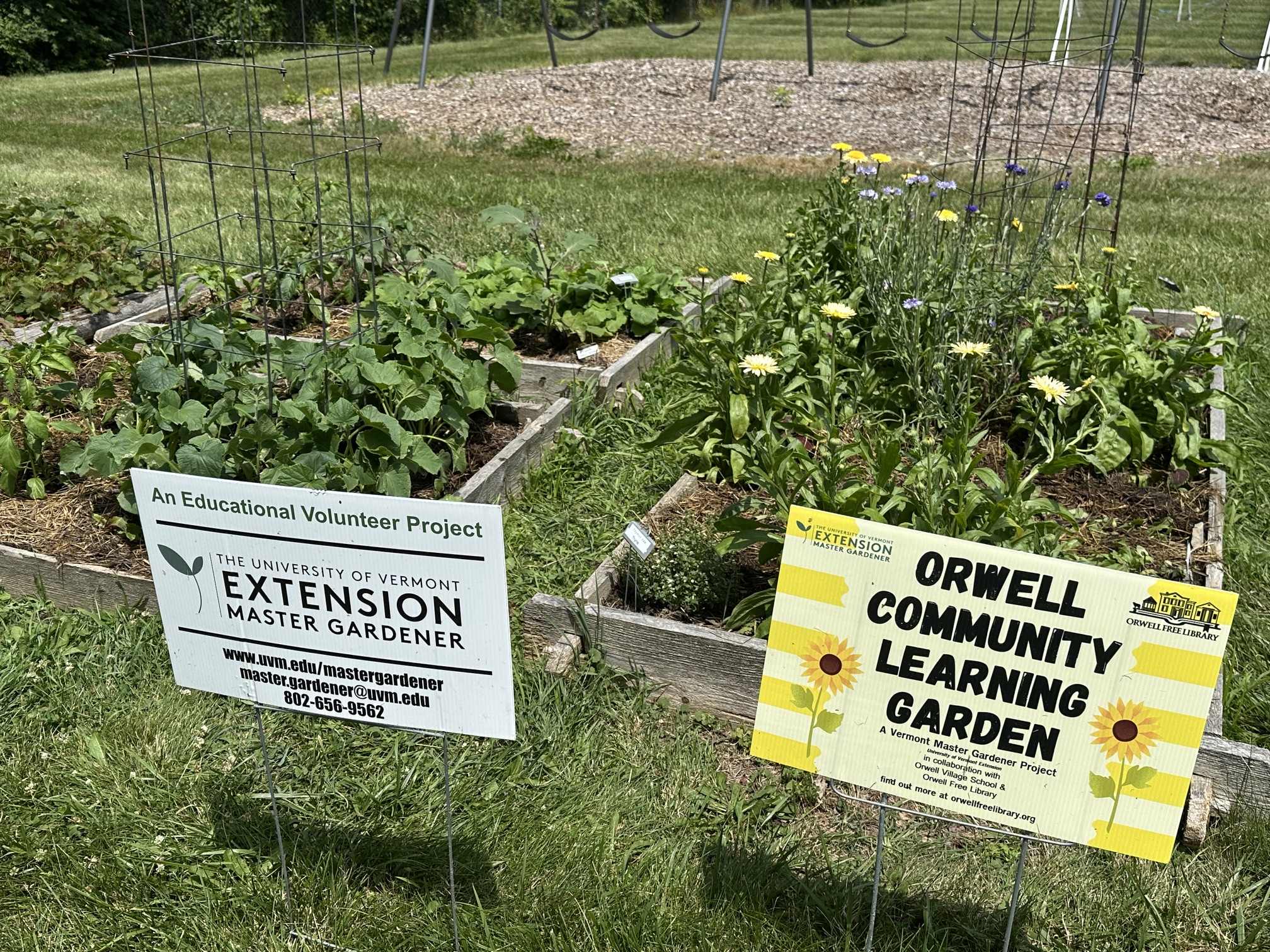
Please look at the accompanying photos for pictures of this damage, as well as some of the progress we made throughout the day, but also please note our new signage—a huge thank you to Library Director, Kate, from the Orwell Free Library, for these beautiful additions to our gardens! Some other pictures this week include an almost fake looking cricket (I have never seen a cricket this striking before!), cucumber seeds that are up around a climbing tower, and our newly flowering, gorgeous perennials.


Starting this week (week of June 22) our Community Garden open hours will move to Thursday mornings at 10am, and this will continue until the start of school. Please follow the Orwell Free Library’s Face Book page to see updates in case there is a week where we can’t be there, or if there will be postponement due to weather. You are also welcome to email either Christina or myself to check if we’ll be there.
Happy Summer, and see you in the garden!
Karen DeMoy and Christina Shaw, UVM Extension Master Gardeners
Strawberry Rhubarb Crisp
Fruit filling:
3 cups rhubarb, peeled and diced into ¼” chunks
2 cups fresh strawberries, hulled and cut up (pieces should not be too small)
2 Tbs corn starch
¾ cup granulated sugar
(I also added 1 tsp vanilla, but this is optional)
Topping:
½ cup flour
1 cup oats (quick OR old fashioned)
½ cup packed brown sugar
¼ tsp salt
½ cup cold butter
Directions:
- Preheat oven to 375 degrees. Grease 8” x 8” baking dish and set aside.
- Toss to combine the rhubarb, strawberries, cornstarch and granulated sugar until all the fruit is well coated. Pour into greased baking dish.
- In another bowl, stir together flour, oats, brown sugar, and salt. But the cold butter into the dry ingredients with a pastry blender. Work in the butter until the mixture clumps together into crumbs.
- Top the fruit mixture with the crumb topping.
- Bake for 30-35 minutes, until the crumbs are browned slightly, and the fruit is bubbly.
- Serve warm with ice cream and/or whipped cream.
Recipe courtesy of “Chocolate With Grace”, by Mary Younkin.
June 25, 2026

We had a great turnout today! On this first weekday gardening session for the Orwell Community Learning Garden, we had two certified EMGs, myself and Christina Shaw, two master gardener interns, Jill and Karen, and a community member, Mia, who helped the entire time, just to learn about gardening. There were also two other community members who stopped by. We are so pleased to see others also excited about our community garden project!
Today we finished planting—a sungold cherry tomato plant (Solanum lycospericum), (and really, in my opinion this is the only cherry tomato one needs!), Genovese basil plants (Ocimum basilicum), and kohlrabi (Brassica oleracea var. gongylodes) seeds. The sungold tomato and basil were donated by Singing Cedars Farm—thank you very much! We put out all the labels today, as well. You’ll notice that I’ve been including the Latin or scientific name for the plants (at least when they are mentioned initially). These names help avoid confusion when trying to differentiate plants.
Many plants, especially perennials, will have many everyday or colloquial names, and it may be misleading if you and your neighbor don’t realize you’re discussing the same plant. We also added two new native perennials today: liatris (Liatris spicata) and native bee balm (Monarda spp.). Liatris is also known as blazing star, or gayfeather, and bee balm may also be called bergamot. I will try to be consistent with the names throughout.

Once the final things were planted, we applied a general organic fertilizer surrounding the larger plants, careful to not actually touch the plants/stems, watered everything in well, then mulched all the beds with straw. The straw will help suppress weeds, and more importantly, will help hold moisture in, allowing us to water less frequently. This was incredibly helpful to us last summer during the months of drought. The rain gauge showed 0.3” of rain this week. This is interesting since last weekend forecasted a soggy week, which did not happen.

Thank you again to the Congregational Church for allowing us to hook up our hose for watering once more this year. Circling back to the point above about not letting fertilizer touch the plants/stems. Fertilizer is very concentrated and “salty”. If it comes in contact with the plant, it will act osmotically and draw water OUT of the plant, and can kill it. If allowed to touch the leaves, it can also burn them, leaving a damaged plant that will be more susceptible to disease.
There were only a few straggler strawberries to harvest, and they made their way directly to our mouths. Not enough to save, unfortunately. It’s always sad when the strawberries are done for the year. We did see some fruit on the sweet peppers, and a few on the tomato plants, so it won’t be long until we have produce to share at the Orwell Free Library. Watch for the posts and pictures on Facebook, or just stop at the library on Thursday afternoons. If people are interested, there are some herbs that could be picked, if you’re short for a recipe—dill, sage, basil, thyme, lemon thyme, Tulsi basil, and rosemary are all ready to have a few stems cut.
There was a bit more damage to plants this week. A rabbit ate an entire cabbage plant, likely. The kale from last week is trying to grow again.
Some of the seeds have germinated from last week—beets, turnips, rutabagas, and radishes are all up. I love a radish for how fast they grow! We’ll be ready to harvest them in two weeks.
See you next Thursday at 10am, Happy Gardening!
Karen DeMoy & Christina Shaw, UVM Extension Master Gardeners
(Sorry, no recipe this week. I am writing this in the airport before flying to England tonight!)
7/9/2026
Wow. It was another very hot day today. We actually cancelled the previous week’s work day due to extreme heat, but apparently this is the new normal, so we’ll try not to cancel again for weather. At my house, on Saturday, July 4th, we had a nice rainfall of at least 0.5”. I did not go down to water the beds on Sunday, nor did I check to make sure that it had rained down in town. Well, it did not. I went to check on things on Tuesday the 7th, and the beds were DRY. Zero moisture in the rain gauge. Needless to say, I watered nice and thoroughly. Everything looked OK, but I am glad I went down to check.
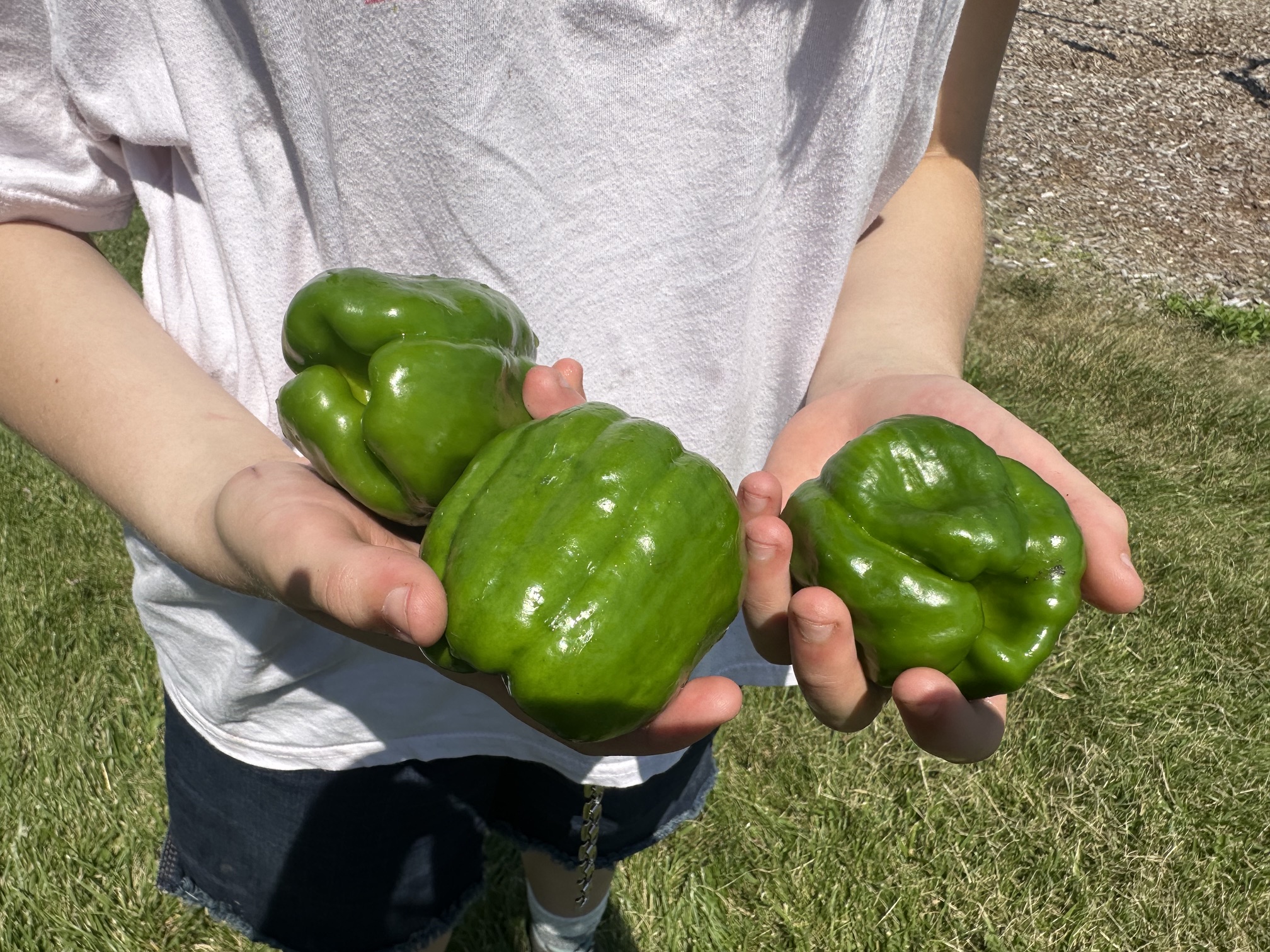
On Thursday, the 9th, we had another nice turnout for our regular work day. Community member M came again and helped us weed, water, and went home with half a pound of fresh, sweet, green peppers—our first real harvest. We also had returning EMG interns Carol and H, as well as a new intern, Liz. We all worked for about 2 hours, watering, weeding, and mulching the beds that had not been done, as well as covering the beds a little more thickly, as we are seeing how quickly the beds are drying out.
We pulled the arugula and spinach that was going to seed, and planted new mesclun mix and arugula seeds in their place. Last year we let the arugula go to seed and then collected these seeds for our seed library (housed at the Orwell Free Library, right across the street from our garden, one of our sponsors!). We still have a fair amount of these seeds, so we did not save these this year.
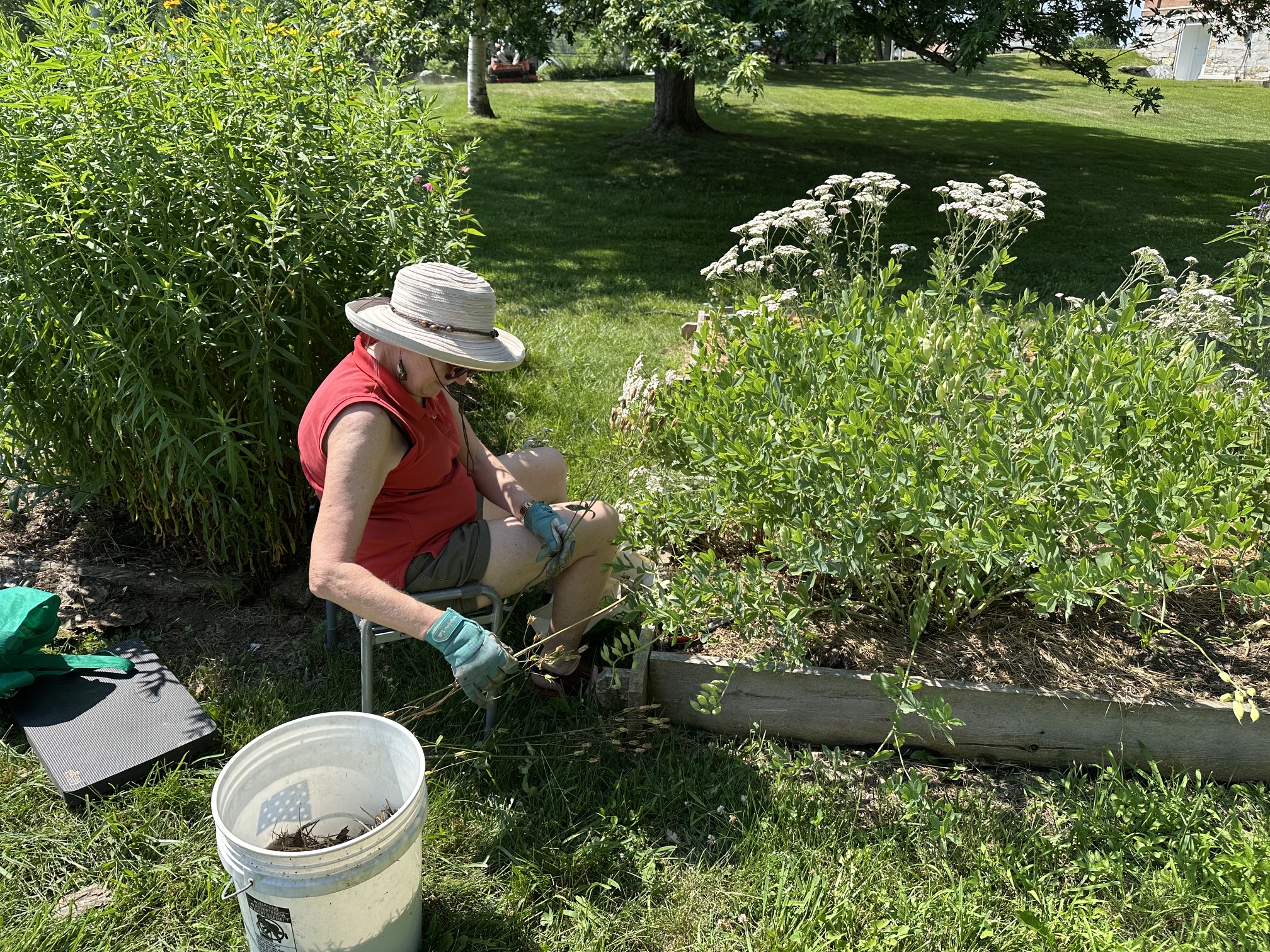
Speaking of seed collection, we collected the pods from the columbine this week. We knew they were ready as the pods were all brown and dry, and the seeds “rattled” inside when shaken. We cut these stems and put them in a bag to continue to dry, and will shake them loose and collect these seeds. These are the native, wild red and yellow columbine, and they will be available soon over at the seed library. We also collected coreopsis seed heads, and there are already bachelor button and calendula seeds from the plants that reseeded themselves from last year.

We didn’t thin any of these “volunteers” this year, as we were just happy to see plants with flowers ready to bloom this spring when we went to unearth the beds. However, next year we will likely have to thin some of these unless we want full beds of these flowers. While you can use the calendula flowers for teas and tinctures, we would rather have the space for some veggies, I think. This year they are just right, helping to pollinate our veggies, and bring some color to our beds.
There are some nice vegetables almost ready to harvest, including summer squash, zucchini, eggplant, cherry tomatoes, and radishes. I think that if there had been some more moisture, the squashes would be overflowing by now. With the lack of rain, you can see some of the fruits are stunted, so we culled these, to allow the healthier fruits to thrive.

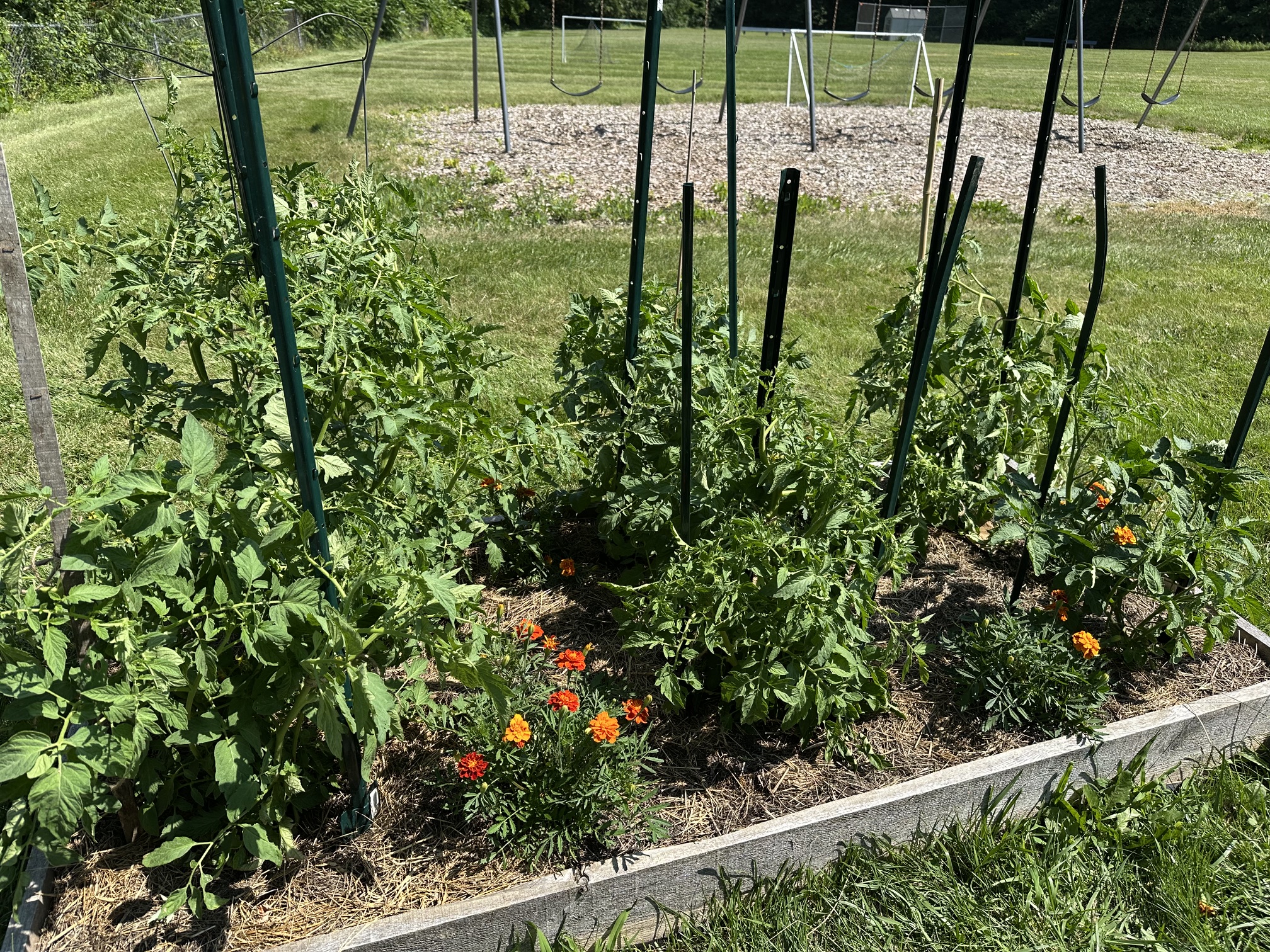
I staked up the tomato plants with twine and various stakes and a few tomato cages we had donated. They truly will do fine with any kind of support—they make nice tomato clips that can be reused, but twine works fine as long as it is not too binding around the stems.
The goal is to get the leaves and fruit off the ground where they will pick up diseases and excess moisture; allow for better air flow among the leaves and flowers—this will not only prevent diseases by preventing excess moisture, it also allows for better pollination of the flowers if they are not all in a clump. Once these are staked and adjusted after a few weeks, we can see where there are excess stems and do some pruning, to allow better fruit to “set”. We don’t want the plant to spend all of its energy in growing the plant and leaves—we want it to produce the fruit that we can pick and eat. We’ll keep you posted on this, and show some pictures as the fruit hopefully ripens in the next few weeks.
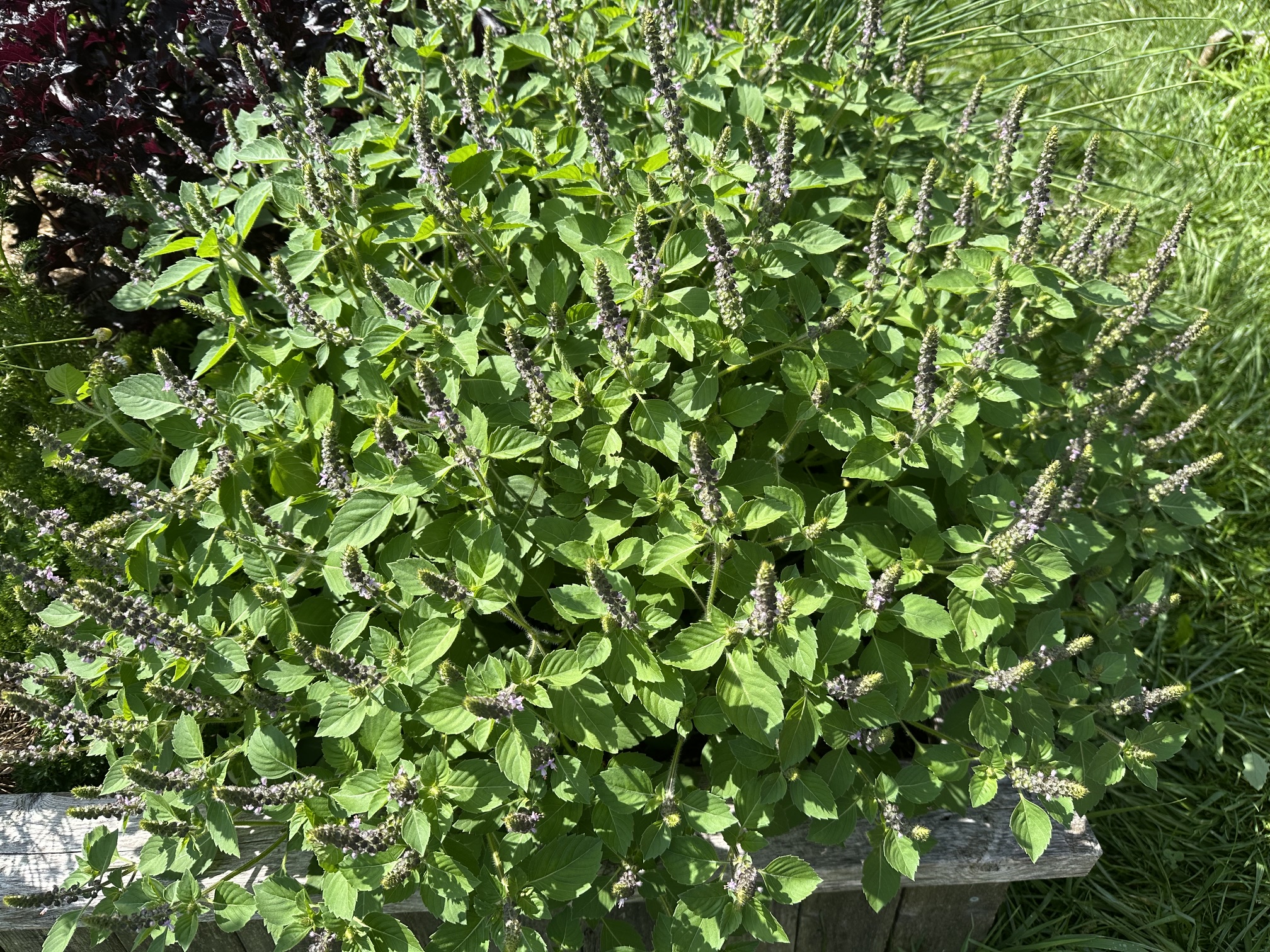
In the first bed, closest to the parking lot, there are herbs all ready to pick. Look for sage, parsley, chives, Tulsi basil (I cannot believe the number of volunteers we thinned out of there in the past few weeks from last year’s plant—crazy!), Genovese basil, and chamomile. The allium species in this bed (shallots, leeks, and scallions or bunching onions) need a little more time yet, but may be ready for light picking soon.

On the horizon we have a few projects to add to the regular tasks of watering, weeding, and harvesting. One of these is a mapping of the beds, both on paper and with permanent signage—posts with hanging wooden signs with what is planted in each bed, and with a notice for what is ready to pick. I saw this idea at the Duke University community garden in North Carolina last fall. I took some pictures and spoke with their caretakers. They are on a very different level than us, but inspiring. Interestingly, the gentleman I spoke with there had been a UVM EMG in Vermont for 25 years before moving down south just a few years ago. The gardening world is small, and there is always something to learn!
Until next week, happy gardening! Stay out of the sun, and keep your gardens watered!
Karen DeMoy and Christina Shaw, UVM Extension Master Gardeners
Spicy Thai Basil Chicken (Pad Krapow Gai), (All Recipes)
- ⅓ cup chicken broth
- 1 tablespoon oyster sauce
- 1 tablespoon soy sauce, or as needed
- 2 teaspoons fish sauce
- 1 teaspoon white sugar
- 1 teaspoon brown sugar
- 2 tablespoons vegetable oil
- 1 pound skinless, boneless chicken thighs, finely chopped
- ¼ cup sliced shallots
- 4 cloves garlic, minced
- 2 tablespoons minced Thai chilies, Serrano, or other hot pepper
- 1 cup very thinly sliced fresh Tulsi basil leaves
- 2 cups hot cooked rice
Directions
- Gather ingredients.
- Whisk chicken broth, oyster sauce, soy sauce, fish sauce, white sugar, and brown sugar together in a bowl until well blended.
- Heat large skillet over high heat. Drizzle in oil. Add chopped chicken and stir fry until it loses its raw color, 2 to 3 minutes.
- Stir in shallots, garlic, and sliced chilies. Continue cooking on high heat until some of the juices start to caramelize in the bottom of the pan, about 2 or 3 more minutes.
- Add about a tablespoon of the sauce mixture to the skillet; cook and stir until sauce begins to caramelize, about 1 minute.
- Pour in the rest of the sauce. Cook and stir until sauce has deglazed the bottom of the pan. Continue to cook until sauce glazes onto the meat, 1 or 2 more minutes. Remove from heat.
- Stir in basil. Cook and stir until basil is wilted, about 20 seconds. Serve with rice.
- Serve hot and enjoy!
July 14, 2026
This Thursday was a beautiful day! The severe humidity had broken, and there was a very nice breeze for Nancy, H, and I to be working in the garden beds.

There was 1.2” of rain in the gauge, which was glorious, but we still needed to water these beds that drain so quickly. The mulch is helping, but a much better soaking will be needed before we will be safer from the plants drying out. However, it all helps! We did some quick maintenance of weeding and deadheading/cutting back some perennials, and then got down to the real business for today: preparing our new raised bed.
We are very fortunate that someone donated two blueberry bushes to our garden—thank you very much! These will be a nice addition as they are native to the Eastern U.S., and will offer a sweet treat to the townspeople who need a few cups of blueberries during the summer for a favorite baked dessert, or just a handful to add to their morning yogurt. Blueberry bushes are actually fruiting right now, so while there are a few berries on these bushes, we will not get a large harvest for a few years. But, maybe at least a few handfuls next year, fingers crossed!

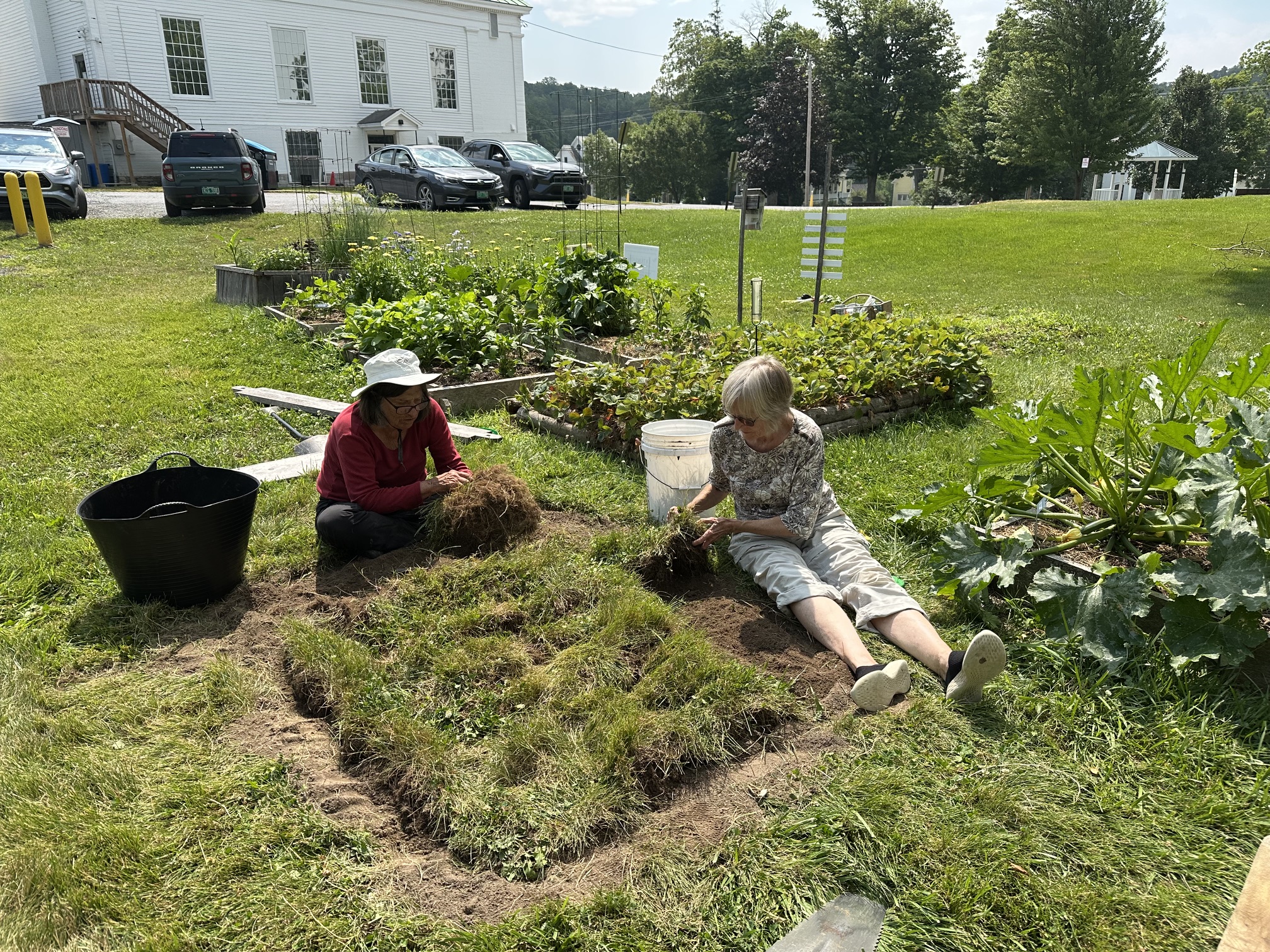
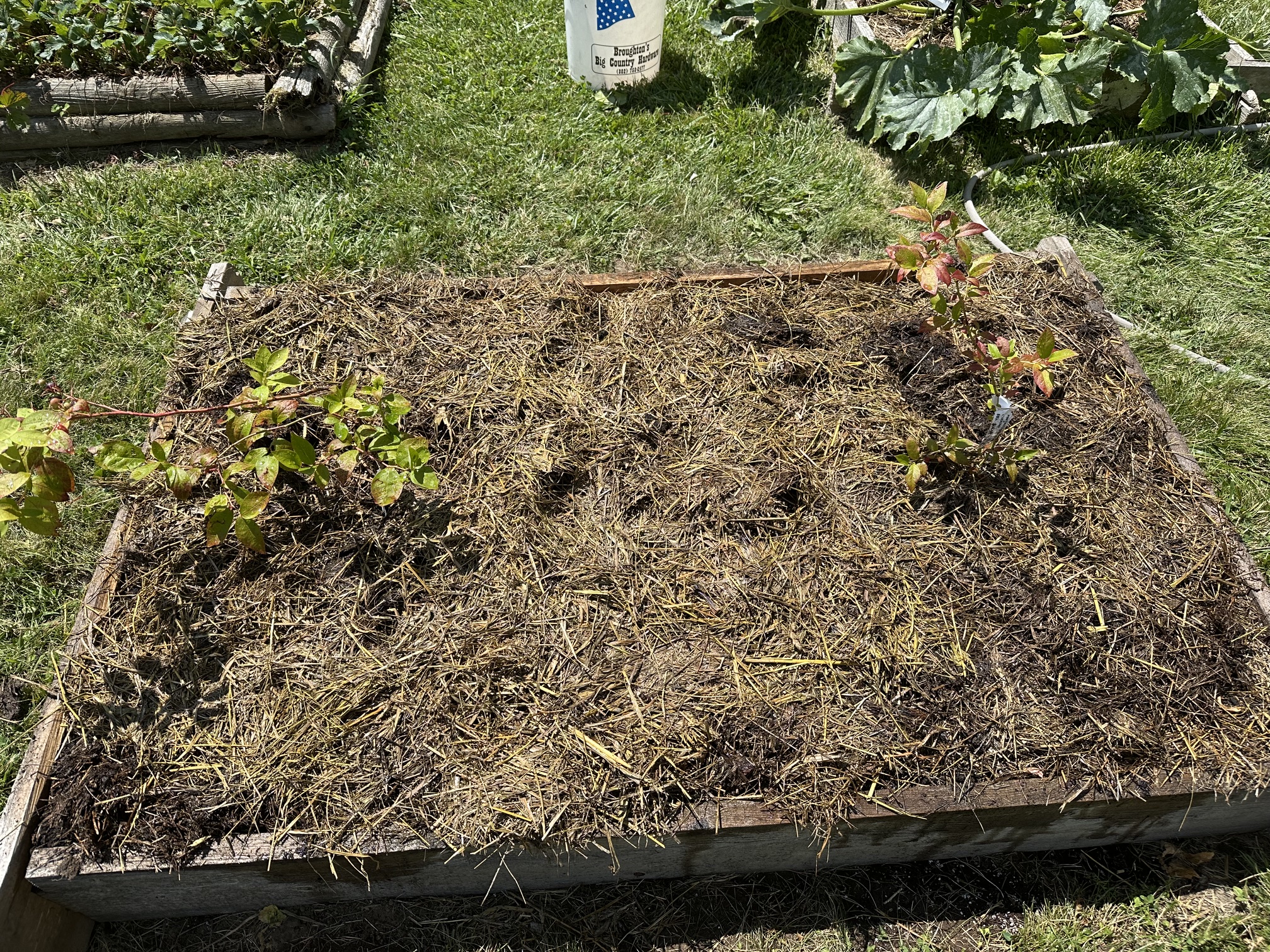
The first thing we had to do was to remove the sod for the bed, which measures 4’ x 6’. We are treating this bed a little differently than the other new ones that we installed last year. Because these bushes are perennials with deep root systems, we are not putting weed block fabric at the bottom of the bed. This will result in some weeding in the future, but it will allow the roots to go deeper, and access the nice soil that is already present. (We are hoping that once these bushes are established, they should last for many years to come.)
Once all the sod was removed with a spade, and the dirt “beaten” out as much as possible, we loosened the soil to lessen the packed down nature that is present in well-trod lawn such as this. We removed a bit more sod than just the 4’ x 6’ area, to give a little buffer, then we assembled the cedar bed. Next week we will fill it with soil and amendments, and then plant the bushes. (More on the special amendments required for blueberry bushes specifically, next week.


At the end of our morning, we harvested vegetables, herbs, and flowers, totaling 5.25 lbs today—not bad for early July! The harvest consisted of radishes, zucchini, yellow squash, eggplant, basil (Tulsi, purple ruffled, and Genovese), parsley, rosemary, and sage. All of this went directly over to the library and was hopefully taken quickly!
We also were able to pick a beautiful bouquet of flowers, including bachelor buttons, calendula (both of these reseeding from last year, bonus!), yarrow, mountain mint, echinacea, blue vervain, and baptisia greenery. I just love fresh flowers, and while I am not going to win any prizes for my arrangements, they are pretty any way they are put together, I think.
Lastly, over the weekend I was able to gather some of the seeds we have collected already this summer, including lanceleaf coreopsis (Coreopsis lanceolata), and native red/yellow columbine (Aquilegia canadensis). In addition, the dill weed that we collected in the first weeks of the garden has been dried and packaged up into small containers, free for the taking to use all year round. Come and get your seeds and dried herbs at the Orwell Free Library, while they last!
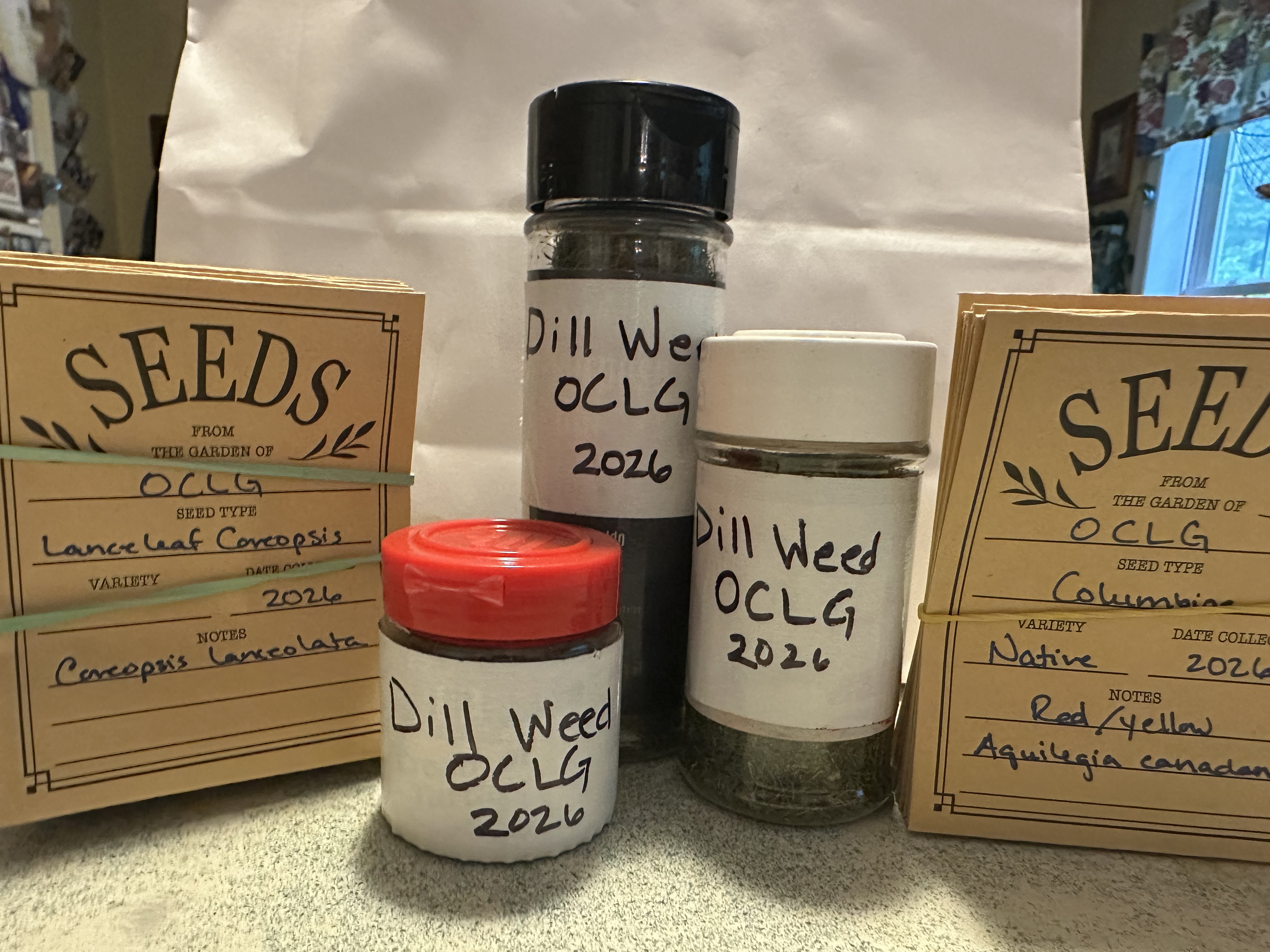
Enjoy the first zucchini recipe of the season, and see you next week!
Karen DeMoy and Christina Shaw, UVM Extension Master Gardeners
Crustless Zucchini Pie (Recipe courtesy of Skinnytaste online)
10 oz zucchini or yellow squash, shredded and all liquid squeezed out
½ cup shallots (or onions), chopped
¼ cup fresh chives, chopped
½ cup cheese, shredded (cheddar, mozzarella, other to your taste, or a mixture)
2 Tbs parmesan cheese, grated
½ cup flour (AP, gluten free 1:1, or white whole wheat)
1 tsp baking powder
2/3 cup milk
1 tsp extra virgin olive oil
2 large eggs, beaten
½ tsp salt
Black pepper, to taste,
Cooking spray
Directions:
- Preheat oven to 400 degrees. Lightly spray pie dish with cooking spray.
- Combine zucchini, shallots, chives, and shredded cheese in bowl, and mix.
- In a separate bowl, add flour, baking powder, milk, eggs, salt, and pepper, and mix well.
- Combine zucchini mixture and flour mixture, then pour into pie dish. Top with parmesan cheese.
- Bake for 30-35 minutes, or until knife inserted in middle comes out clean.
- Let stand for at least 5 minutes prior to cutting and serving.
July 23, 2026
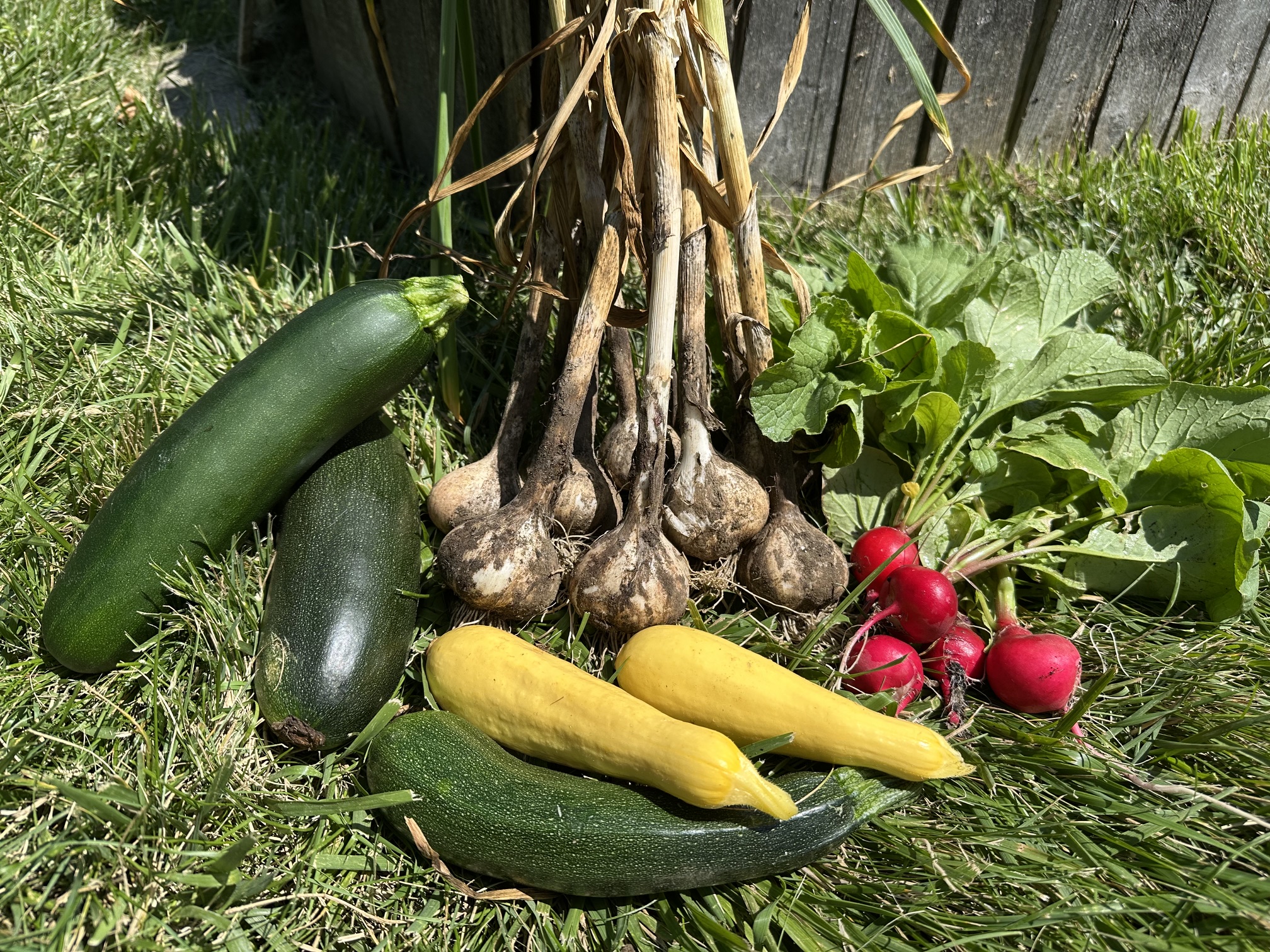
It was nice weather once again for Christina, Carol, H, Liz, and our teen volunteer M to tend to the garden beds. There was only 0.2” in the rain gauge, so after all the tasks were accomplished, we gave everything a nice soak. We harvested 7.4 pounds of produce today, including radishes, yellow squash, zucchini, lettuce, chard, arugula, kale, chicory, fresh dill, and 10 beautiful garlic bulbs. I made another flower arrangement that consisted of bachelor button, calendula, heliopsis, echinacea, mountain mint, boneset, and baptisia greenery. It was a nice spread at the Orwell Free Library, and I hope it all went quickly!

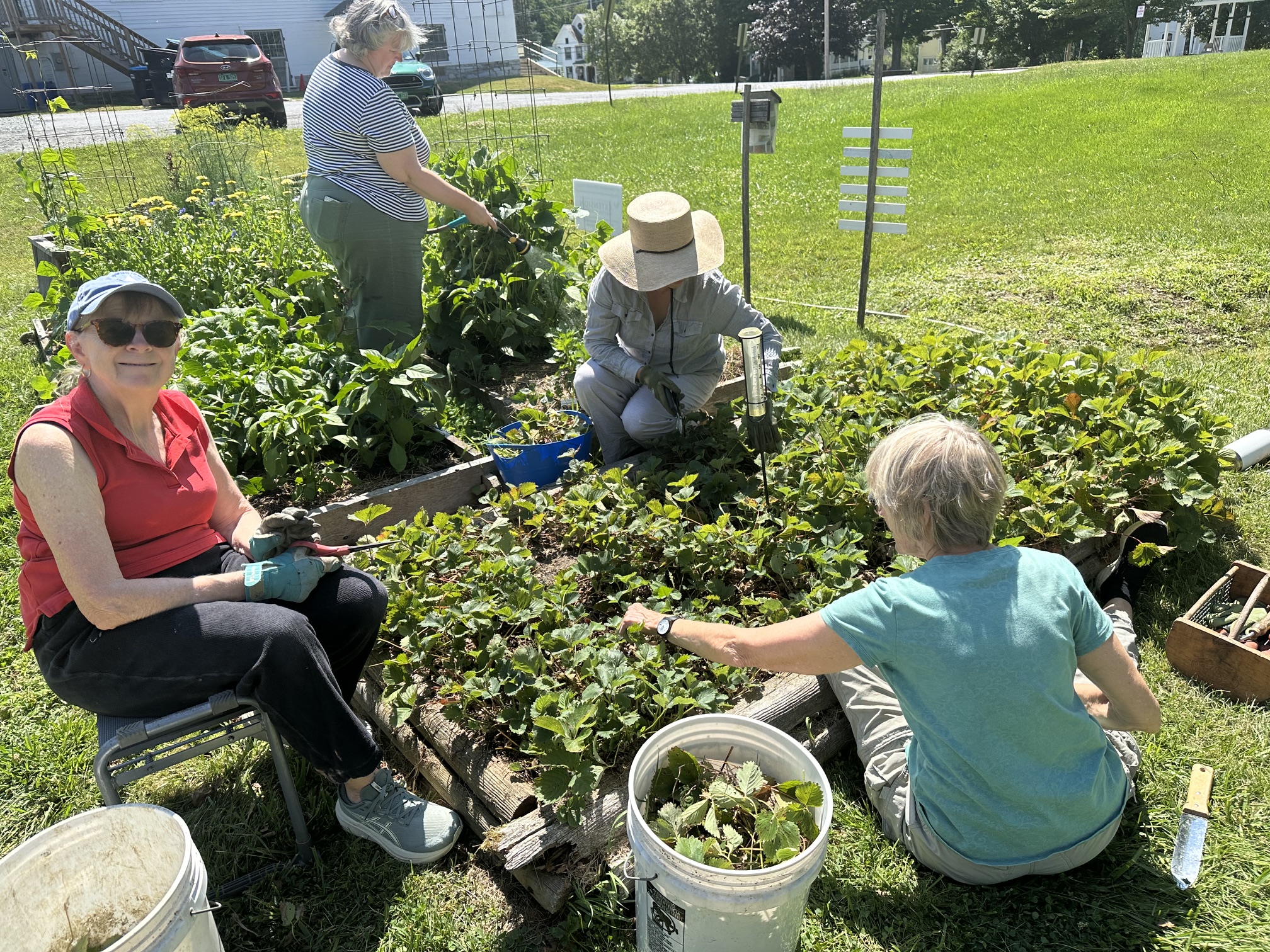
Besides the regular tasks of weeding, a little pruning of tomato bushes to allow more air flow, harvesting, and watering, the main two main projects for today were weeding and thinning the strawberry bed, and planting the blueberry bushes. We divvied up the tasks with Carol, H, and Liz tackling the strawberries, while Christina watered and pruned, and M and I worked on the blueberries.
We filled the already assembled 4’ x 6’ cedar bed with one bale of an all-purpose soil mix, four bags of compost, and multiple buckets of our own compost left over from last year, courtesy of Lazy Dog Farm, right here in Orwell. We planted them just to the crowns, and then supplied them with 1 ¼ cups of organic soil acidifier, containing sulfur and gypsum. This is a safer alternative to previously used aluminum sulfate, which can build up in the soil as a metal, and levels can actually become toxic. We will repeat this application in 60 days, and then again in the spring.
There are certain plants that have very specific soil pH (the range between acid and a base, or alkaline), and blueberries are one of these plants, requiring a more acidic pH than is usually found in normal soils. The scale ranges from 0-14, and right in the middle of the scale is neutral, at 7—this would be pure water. On the very low, or acidic side are things like vinegar (3), lemon juice (2), and stomach acid (2). On the basic/alkaline side are things like soaps (12) and baking soda (9).
Many plants in general thrive in just slightly acidic soils, from 6-7, whereas blueberries require much more acidic levels, from 4.5-5.5. This is different enough from most soils that we must “amend” them, meaning we add things to the soil to change its composition. This acidic nature of soil allows it to specifically “let go” of certain minerals that blueberry roots need to absorb (iron, manganese, and zinc). In addition, at this pH, certain microorganisms are more active, and these aid in nutrient cycling that are specifically beneficial to a blueberry plant. Luckily this has all been discovered for us, and we can help our blueberries have the best start towards happy plants, and eventually high fruiting.
One other factor that is important for any new planting is of course, watering. It is so important to not let new plantings dry out as they are establishing their root systems, so Christina and I will keep an eye on the weather, and Christina will plan to come during the week to water if we do not get rain. As with all the other beds, we mulched this one heavily, so it will hopefully hold onto the water as much as possible. We look forward to blueberry muffins, buckle, pancakes, and more in the future!


After harvesting the radishes, that area was all empty, so we planted another cycle of these red beauties. We also filled in some empty areas in the beet and carrot rows, now that the initial plantings are all up, and we can see where they did not germinate as well. Lastly, we pulled some of the arugula plants and planted a next crop of mixed lettuce greens. Many of the leafy greens (lettuce, kale, spinach, arugula) prefer a slightly cooler, less intense heat than some other plants. This is why they have been strategically planted in bed 11, since this bed is shaded during the worst heat of the day. (Please stay tuned for an updated map of the garden beds, and what exactly is growing in each. We have an exciting plan, likely for next spring, of some permanent signage with a key to not only what is planted in each bed, but also what is ready for picking at any given time.)
Ok, that was a lot of science for today! Next week there will be a discussion on garlic—when to plant, when to harvest, and a discussion of the different ways to “cure” the bulbs after they are dug. (Note—even amongst us EMGs, there was no one consensus on the “correct” way, so we’ll let you all know some of our methods, and what works best for us.)

Please see this oldie but goodie zucchini recipe from my family below. I would never have thought to try zucchini raw in a salad like this, but it is very tasty, so simple, and a great one to bring to a gathering. I am just noticing now that we have all of these ingredients in the OCLG, except for oregano. Well, that is an easy thing to remedy—we will tuck some oregano into one of the beds as a wonderful perennial herb. Enjoy!
See you next Thursday, 7/31/26, 10 am. Until then, happy gardening!
Karen DeMoy and Christina Shaw, UVM Extension Master Gardeners
Zucchini, Tomato, and Fresh Herb Summer Salad
(Credited to Land O’Lakes Treasury of Country Recipes Cookbook)
2 cups of cherry tomatoes, halved or quartered, depending on size
2-3 cups fresh zucchini or small summer squash, halved or quartered, sliced ¼” thick
4 oz cheese, cubed—I prefer cheddar, but mozzarella, Monterey jack, or other would work well
2 Tbs extra virgin olive oil
2 tsp balsamic vinegar
1 Tbs fresh oregano, chopped
1 Tbs fresh basil, chopped
½ tsp sugar
½ tsp garlic salt
½ tsp black pepper
Combine veggies and cheese in bowl.
Mix the dressing ingredients well and pour over veggie mixture.
Toss to coat.
Best flavor if allowed to set at least 30 minutes in fridge prior to serving.
July 31, 2026
Today was a bit of a weird day in the gardens. We actually cancelled our scheduled open hours due to heavy rain—which we are most thankful for! However, the weather cleared later in the morning, and I went over to check the rain gauge (2.8”!) and see if anything needed harvesting.
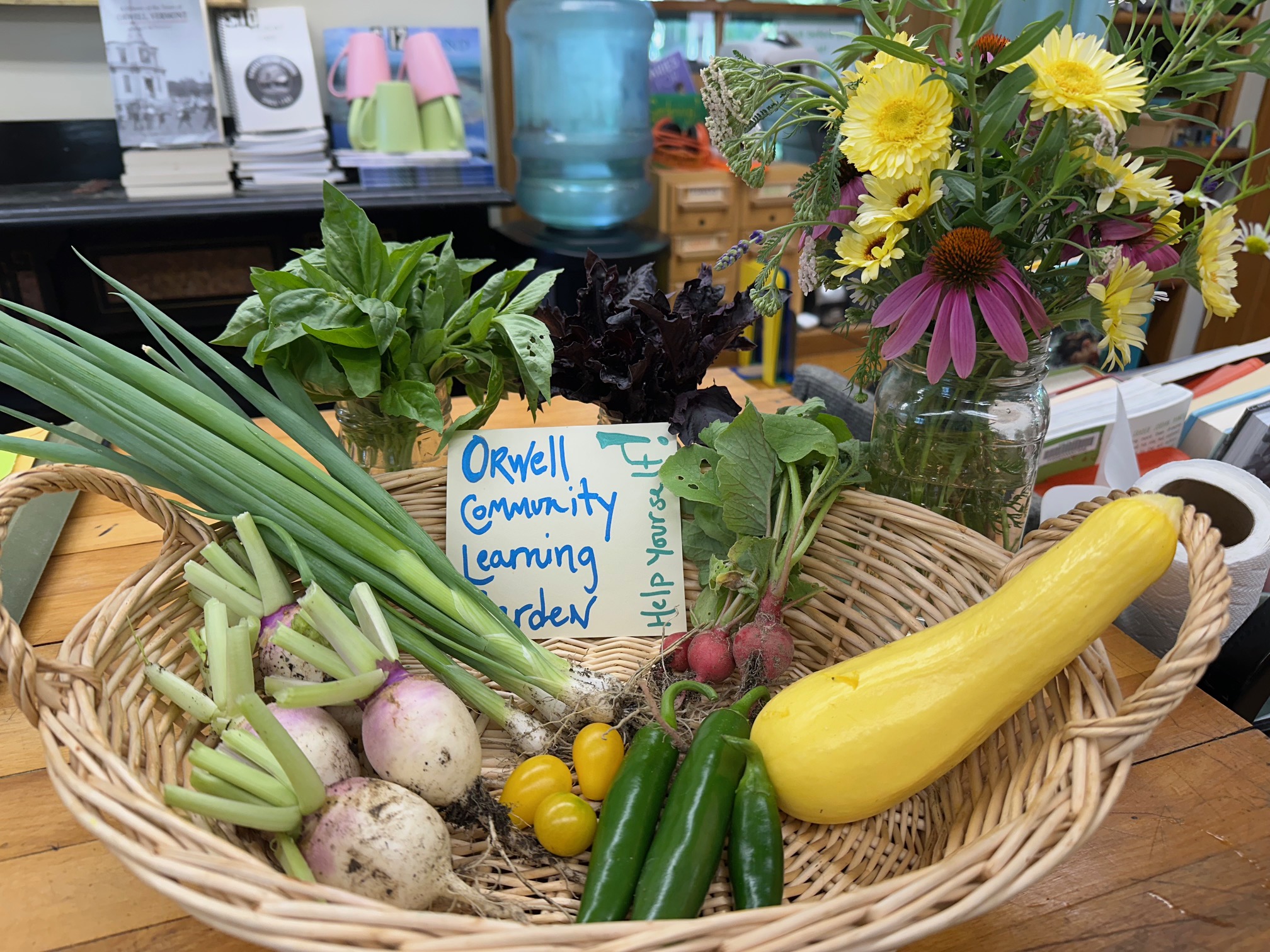
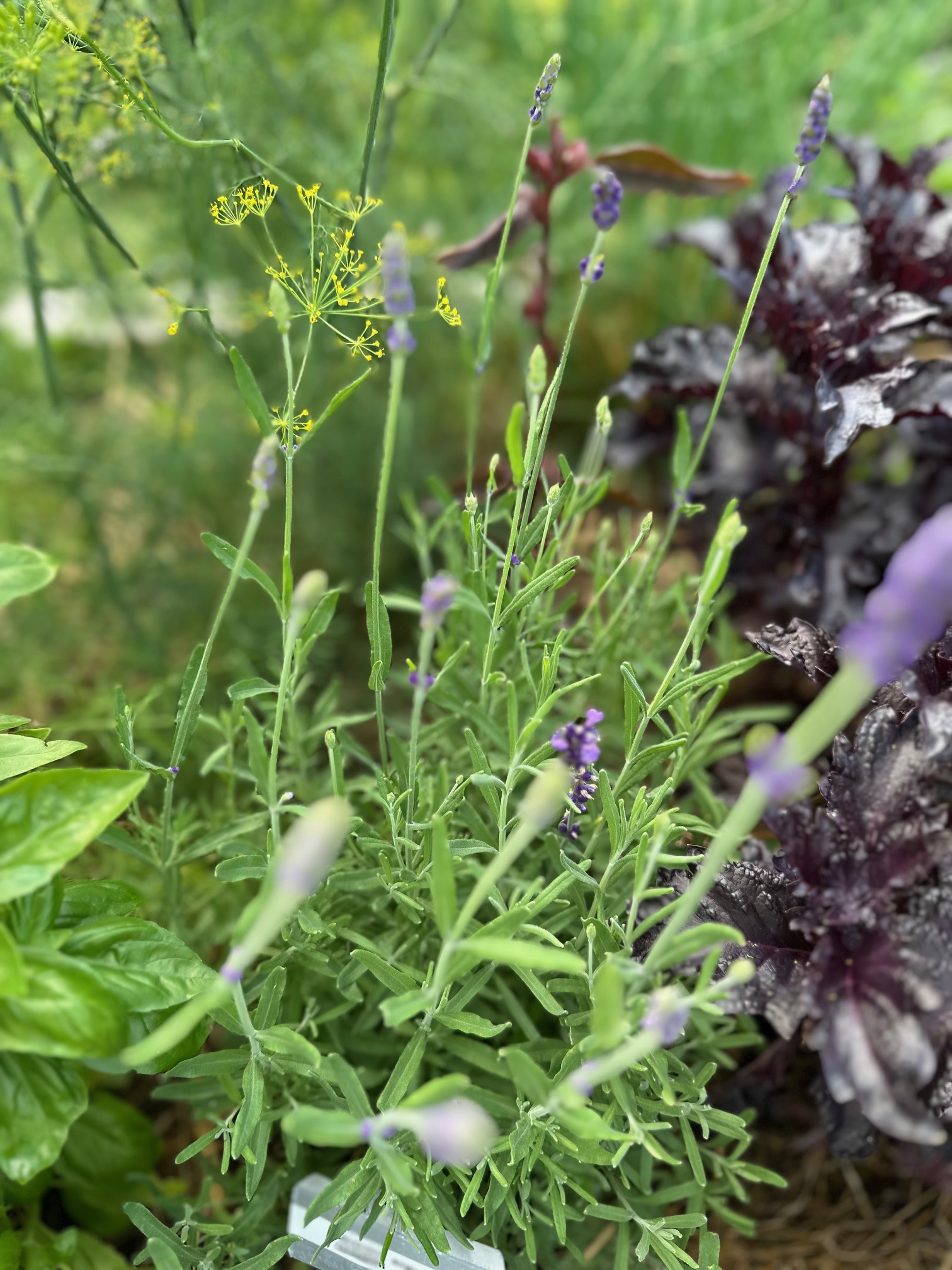
I brought 2 pounds of produce over to the Library, including: yellow squash, radishes, scallions, jalapenos, cherry tomatoes, turnips, rutabaga, and both purple and Genovese basil. I once again picked a bouquet of flowers to display, including: calendula, bachelor buttons, lavender, yarrow, echinacea, and aster greens. Remember to look for a Facebook post either from the Orwell Free Library, or the Orwell Community Network on Thursday afternoons, or just stop into the Library and see what we picked.
Additionally, anyone is welcome to go to the garden anytime and see if there is anything ripe for the picking! I do think we have some people already doing this, as I have not had to pick any zucchini yet, so thank you!
One topic that I wanted to return to was GARLIC. I mentioned a few weeks ago that we harvested our 10 bulbs, and that there was a debate on how to handle them once harvested, as well as prior to harvesting. Garlic is an interesting crop as it is planted in the fall, about a month prior to the ground freezing—a few frosts after they are planted is fine, but you do want to give them a bit of time for roots to develop prior to the soil fully freezing. Usually you will not see any green shoots above the ground in the fall, (but even if you do, the bulbs should be fine), but will see the greenery come up in the spring. Each bulb of garlic is made up of individual cloves, and this is what you plant—one clove will each turn into a full bulb with multiple cloves by late July the following summer. Once planted, they should be watered in thoroughly, then mulched well with straw, leaves, bark, grass, etc., then left alone until next summer.
In the spring, you’ll hopefully see the shoots from all the cloves, and they grow fairly tall, 1-3’, or more. Sometime in the weeks prior to harvest you will see a “scape” forming. This is a flower stem that grows from the middle of most garlic bulbs. It is advisable to remove these once they are mature enough, so that the energy from the plant goes into continued growth of your harvestable garlic, rather than in making a nice flower/bloom. However, you do not want to remove the scape too early, because it can grow back, thus using even more energy in producing a second flower. The scape will initially be straight, with a bulbous end that comes to a point. Once the scape has curled, remove it at the base of the plant—I usually use scissors, but you can snap them off, as well. The scape itself is also edible and can be used like chives, or as a replacement for garlic in many recipes. One of the most popular uses is garlic scape pesto. If the scape is left on the plant, your bulbs may be smaller at harvest, but it does not harm their flavor, storage-ability, etc. For eating purposes of the scapes, you’ll want to remove them just after they curl, otherwise they will become woodier and less edible.
Garlic is ready to harvest when the lower leaves begin to brown, usually in mid to late July. This part of the harvest is where us EMGs all differed in how we handled the crop. According to the UVM EMG materials (see article from UVM Extension Vegetable and Berry Specialist, Vern Grubinger, “Growing Great Garlic”, October 2022), gentle washing of the bulbs after harvest, or waiting until the dirt has dried, then brushing it off, is recommended. Some of us wash them by hosing off initially, and then letting them dry, while others do not clean theirs off at all. One thing in common is to let them dry, OUT OF the sun (this is very important, as they can burn and their storage ability will be diminished), for a few weeks before moving them to their winter storage. Some people braid their garlic, and hang for storage. While I am an excellent braider of my childrens’ hair, I have never managed to get the hang of this. It does look very cool, if you can figure it out. I then cut the stems off at 2-4”, and store them on our wooden vegetable rack on breathable sack cloth in a single layer. We have been able to keep using our bulbs some years until the next harvest. Sometimes the bulbs dry out too soon. There are definitely different varieties that store better than others (hardneck vs softneck), but it also will depend on when you harvested, how they dried, and just the health of the bulb when it was harvested. We try very hard to pick out the best of the harvest to plant again in the fall for the following year—this way we know this variety did well in our environment. However, I will confess that my personal harvest this year was very disappointing. The bulbs harvested at the OCLG were very nice compared to mine. I do not think I will be planting any of the ones I harvested again. I will do some more research and see if I can find some varieties that may do better. The 10 bulbs will be down at the library in a few weeks, when they are ready to go to their new homes 😊
We had a fun visit with the preschool children today while they were waiting to go home. They may have been more interested in my guest for the day, Ida Mae (see picture of the adorable poodle who was helping me), but they also came over to see what I was doing in the garden and had some questions.

Lastly, I mentioned last week that we did not have any oregano in the garden. I found a small healthy plant at a half off sale at Wood’s Market Garden in Brandon, and tucked it into one of the beds, where it will hopefully thrive for years to come. Speaking of the “beds”, I am working on a new map of the beds, so people can find their way around more easily—maybe next week.




I’ll leave you with a recipe for garlic scape pesto, and see what you think. We’ll see you next Thursday amongst the garden beds! Happy gardening!
Karen DeMoy and Christina Shaw, UVM Extension Master Gardeners
Garlic Scape Pesto (GarlicGods.com)
10 garlic scapes
1/3 cup pine nuts
1/3 cup Parmesan cheese, shredded
½ lemon, juiced
1/8 tsp salt
Pepper, to taste
1/3 cup extra virgin olive oil
- Trim the garlic scapes by cutting just below the bulb, and remove the lower part of the stem that is woody.
- In a food processor, add the scapes, pine nuts, cheese, lemon juice, salt, and pepper. Pulse until mixture begins to break down. Scrape the sides of the bowl.
- With the processor running, slowly add the olive oil. Continue to process until all the ingredients are broken down and incorporated.
- Store in covered container in the fridge for up to one week, or it can be frozen. Freeze in ice cube trays then transfer, once frozen, into freezer storage bags or containers.
August 6, 2026
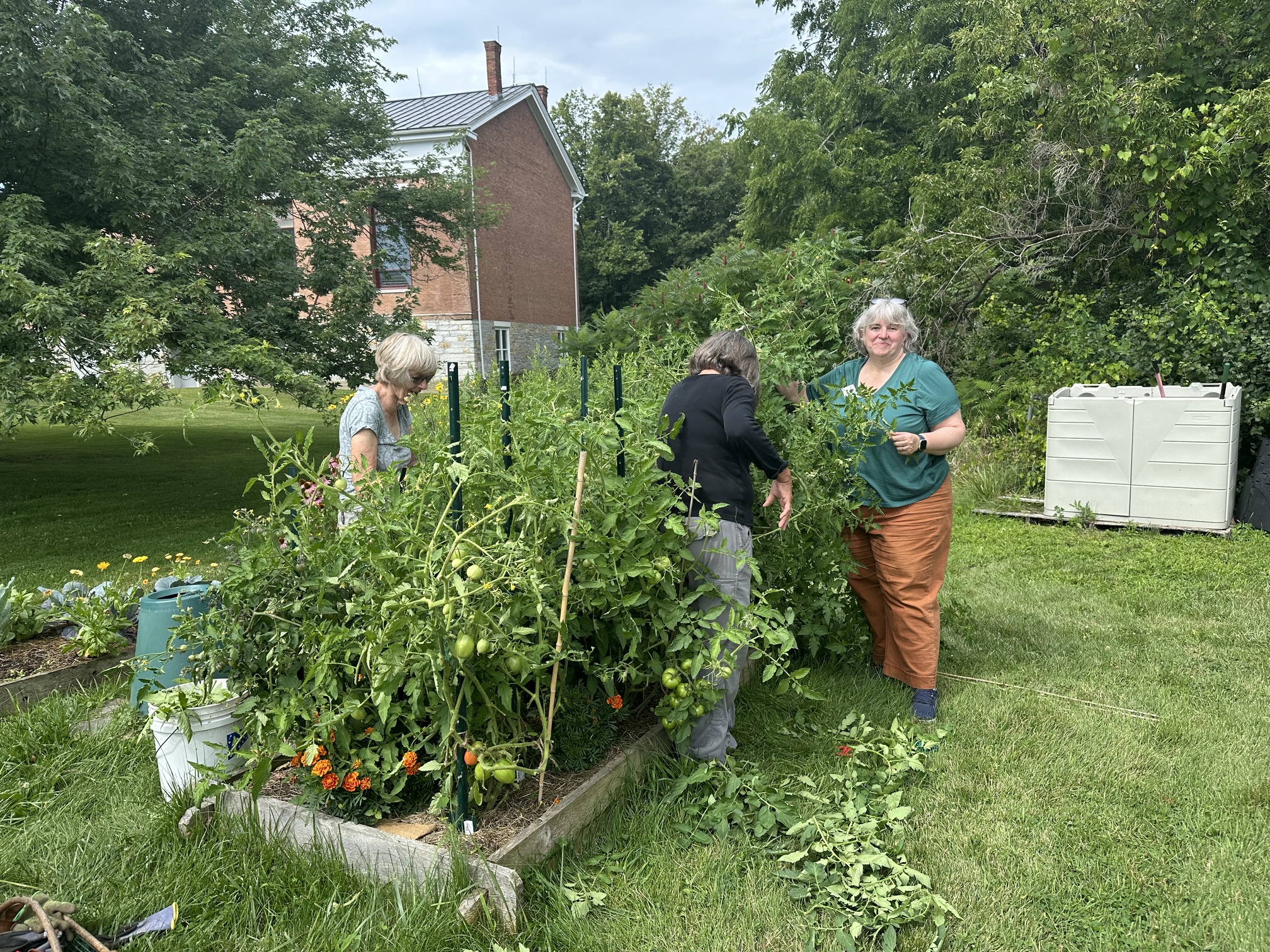
We had a nice turnout for this past Thursday, including myself, Christina, Nancy, and interns Liz and H for two hours of true bed maintenance. It is an immense help to have all this woman-power week after week. With this help, we are able to treat the beds and plantings as they should be treated, with pruning, thinning, and deadheading—all of which helps promote healthier plants and more robust harvests.
Three of us worked on the beautiful bed of tomato plants alone this week, pruning off the excess stems, and any diseased or unhealthy leaves/fruit. The airflow alone will help these already healthy plants thrive even more. Taking off some of the excess growth allows more energy to go into the fruit that has already set, rather than into just producing more greenery and fruit that may not have enough time to ripen. We only are harvesting a few ripe fruit each week so far, but the amount of immature fruit already set is abundant—so be on the lookout in the weeks to come!

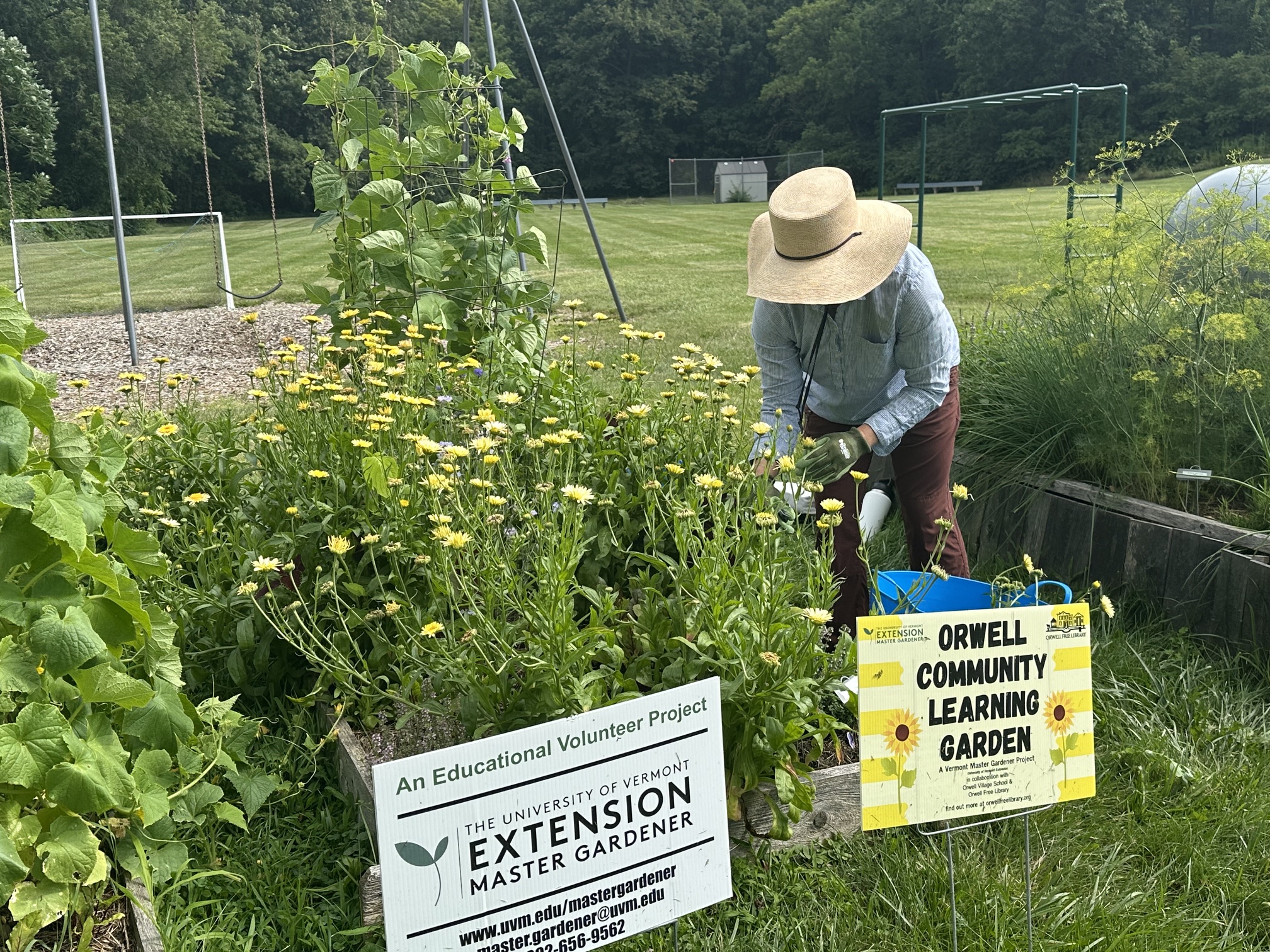
Another master gardener intern worked on bed #2, with one sungold cherry tomato plant, many volunteer calendula and bachelor button plants, as well as beets, pole beans, and oregano. These “volunteer” plants are from the plants last year that were allowed to go to seed, and then the seeds sat patiently waiting for the right conditions this spring, and bloomed nice and early, since they were present all winter! However, they were shading out the tomato and beets, so a good pruning was accomplished to allow more air flow and light to get to the veggies.
Once we harvest the vegetables, we can let the flowers “do their thing”, until we collect as many seeds as we can. Remember, the seed library is available all year round at the Orwell Free Library. All seeds there have been collected either from the Orwell Community Learning Garden, or from other gardens here in Orwell, so you know they are suitable for this zone specifically. A few weeks ago I added lupine, coreopsis, and columbine. This is a good time to come a get a few packets for later summer and fall planting of these perennials.

Another gardener watered all the beds, as they were still quite dry. The rain gauge said we had 3.3” of rain—BUT, no. I realized after I took the picture of the 2.8” of rain from last week, that I never emptied the gauge. Oh well, we can’t all remember everything, right? Instead, there was a total of 0.5” of precipitation for the week. And while this sounds good, it is not nearly enough for these well drained raised beds, and especially the newly planted blueberry bushes. Christina gave everything a nice drink, even though there was rain in the forecast, as you never can know exactly what will happen with the weather.
Lastly, I worked on some deadheading in the perennial beds—including coreopsis, helianthus, echinacea, vervain, and beardtongue. Many of these plants will continue to bloom if the spent blooms are pruned off = “deadheading”. This is done by looking at where the blooms are coming from, and looking downwards, towards the ground. You will often see new “shoots” or flower buds coming off from where the next set of leaves are coming from the stem. Removing the flower above will allow the energy to go into producing more flowers instead of the spent flower drying up and producing seeds. I do like some of them to produce seeds, of course, as this is how we collect the seeds that go into the library. Of course, with perennials, it is sometimes easier to separate a mature plant at the roots to get a new plant to share, but some plants can be grown from seed, and in fact, this method can be safer in some instances. In these current times, sharing mature plants with soil or any material from your own garden, can inadvertently share diseases, and even jumping worms, whose juvenile and cocoon forms may very difficult to see— the cocoon forms are only 1-5mm in diameter, so may just look like a speck of dirt! Washing off bare root plants is the safest way to share mature plants, but even then one cannot be certain to get all of the affected particles.
Because of things like jumping worms, many people are no longer sharing plants, or purchasing from plant sales or any commercial nurseries that are not advertised as “jumping worm free”. This topic is very relevant right now, and this is just the tip of the iceberg. We can discuss this in more detail in the weeks to come, so that everyone can be aware and do their best either not to share this pest, or to inadvertently bring it onto their property.
One thing to look forward to this week at the OFL is the GARLIC that we harvested a few weeks ago. It is looking fabulous and has dried well, and will be available to take home either to eat, or to plant in your garden later this fall.
Lastly, over the past week, many of us Master Gardeners and interns volunteered at the “Ask a Master Gardener” table at the Addison County Fair. It was a great week, and there was a total of over 900 community interactions and questions over those five days, which is amazing.
It’s just a wonderful thing for our communities, and our personal well being, that so many of us are interested in home gardening—whether it is for vegetables to eat or share, perennials for pollinators that will help our food supply, or for cutting flower gardens that brighten our days with bouquets. Thanks to everyone who reads this and is interested in our environment and gardening.
Until next week, happy gardening!
Karen DeMoy and Christina Shaw, UVM Extension Master Gardeners
Zucchini With Shallots (NY Times Cooking)
1.5 lbs small zucchini, sliced into 1/8 “ rounds
2 Tbs extra virgin olive oil
Salt and pepper, to taste
2 Tbs bread crumbs, fresh or prepared
1 Tbs butter
2 Tbs shallots, chopped
4 Tbs parsley, chopped (optional)
- Rinse the zucchini and pat dry. Cut off the ends prior to slicing into the 1/8” rounds.
- Heat the oil in a non-stick skillet. When hot, add the zucchini. Saute over high heat, shaking the pan and tossing gently. Add the salt and pepper. Cook for total of 5 minutes.
- Add the bread crumbs and butter to the pan. When they start to brown, add the shallots. Cook for another 1-2 minutes. Sprinkle with parsley, if using.
August 13, 2026
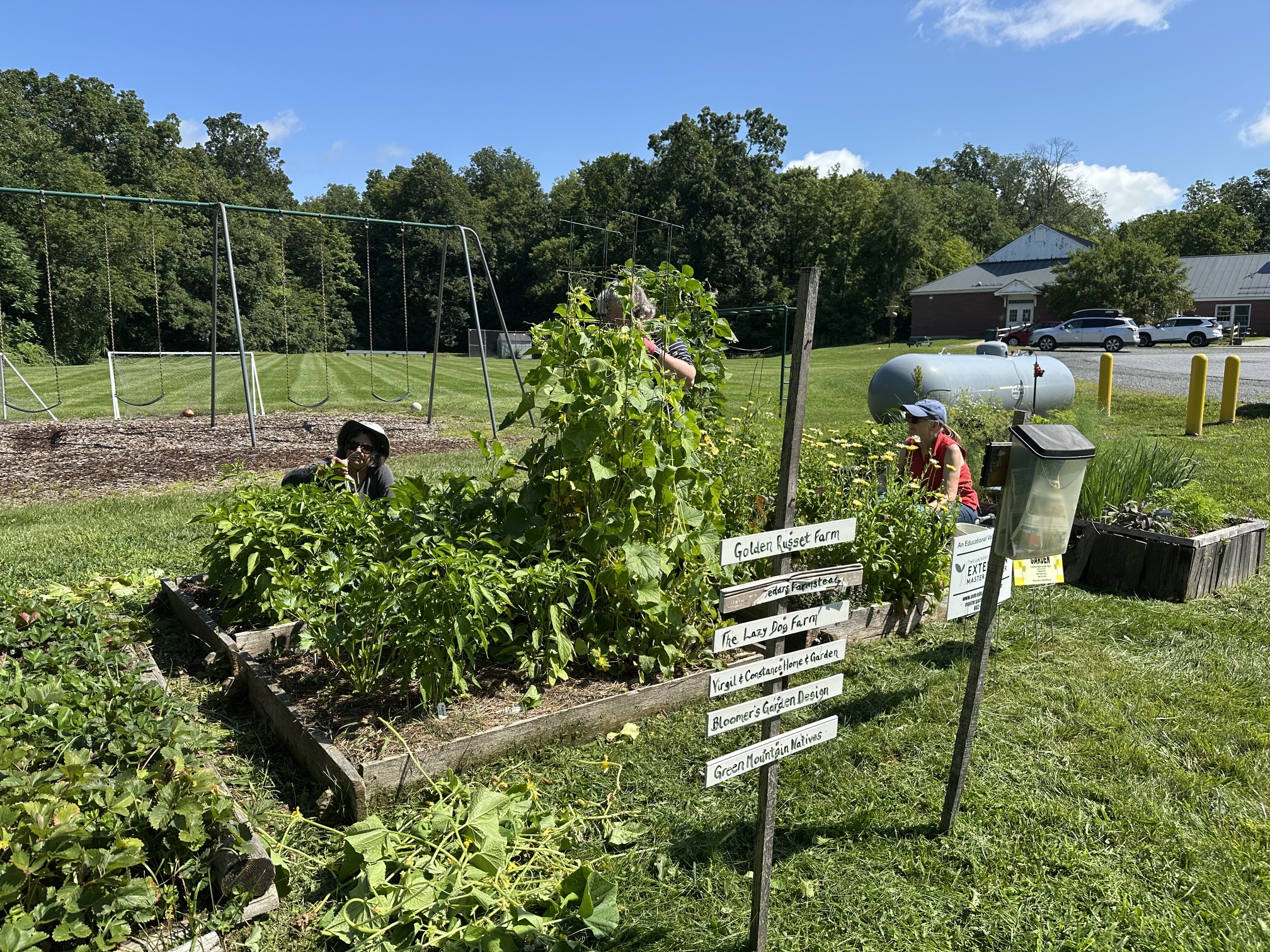
It was a gorgeous day to work in the gardens this past Thursday. It’s hard to believe that summer is nearing the end, as we are just ramping up our harvesting here at the Orwell Community Learning Garden. The beds are looking as good as we have ever seen them, thanks to all the help this summer. Today, fellow EMG Master Gardeners Christina and Nancy, as well as intern Carol, and I all were able to tidy, deadhead, weed trim, thin, and harvest. And since there had been a total of 1.1” of rain the previous week (with most of this Wednesday night), we did not have to water the beds for once!
As mentioned previously, having more help this summer has allowed us to do further maintenance on each bed which helps not only the health of the plants, but also increases productivity of each plant. The health of the tomato plants alone is remarkable, with very little yellowing of the lower leaves, and tall, green plants with a ton of fruit on them. We did trim some of the branches off, removing those with very small fruit, to let the plant be able to send energy towards ripening the fruit already present. We staked the plants up more heartily last week, as some of them were super heavy with fruit and top-heavy branches. We have been lucky, somewhat, to have the drier summer that we have had so far—this decreases the fungal diseases that can build up when the leaves and undergrowth/mulch is too wet. The pattering of the rain (or watering) can actually allow the lower branches to become infected with fungal diseases from the ground, and then it moves up the plant. This is why trimming of the bottom leaves is super important. The most common fungal disease we see in tomato plants is septoria leaf spot, caused by the fungus Septoria lycopersici. A few management strategies to try to prevent this disease include cleaning up your beds in the fall of any leaf litter or plant material (including those pesky dropped fruits), as the fungus can overwinter in the soil. Additionally, if you are using containers for gardening, completely changing the soil and cleaning the pots themselves is super important. Finally, practicing good crop rotation will also help prevent disease in the years to come. Not all plants are affected by the same diseases, so try to rotate on a 3 year basis, if possible, and avoid planting any tomatoes, or related plants (eggplant, potatoes, petunias) in any septoria affected areas.

Nancy brought her battery powered weed trimmer and we cleaned up all around and between the beds. This will help the airflow among the plants—some of the weeds were competing with our cucumbers and eggplants! We weeded the newly planted blueberry bed. Even though we mulched this heavily, there are seeds present in the mulch, and even in our compost from last year.However, keeping up with this will make our lives easier in the long run. (Note: we have three compost bins here at the school, and the first one is our usable compost, farthest to the left, or closest to the road.
We are trying to avoid putting any plant material, especially anything with seeds, into this bin. The one in the middle is where we are putting the new plants and scraps, and the third one is our usable mulch. Eventually, the middle one will break down, and be our next compost, although it may take a bit of time since we cannot turn it as we should.) Check out the UVM Master Composter course for more information on composting: UVM Extension Master Composter Course | NOFA Vermont. We would love to have a certified composter to help us out at this project site, for sure!
Also contributing to our compost piles this week were the trimmed up herbs: dill, Tulsi basil, and chamomile; thinned veggies of cucumbers, rutabaga, turnips; dead/diseased leaves from the squash bed (see note above re: cleaning up the beds); and, deadheaded flowers of echinacea, calendula.

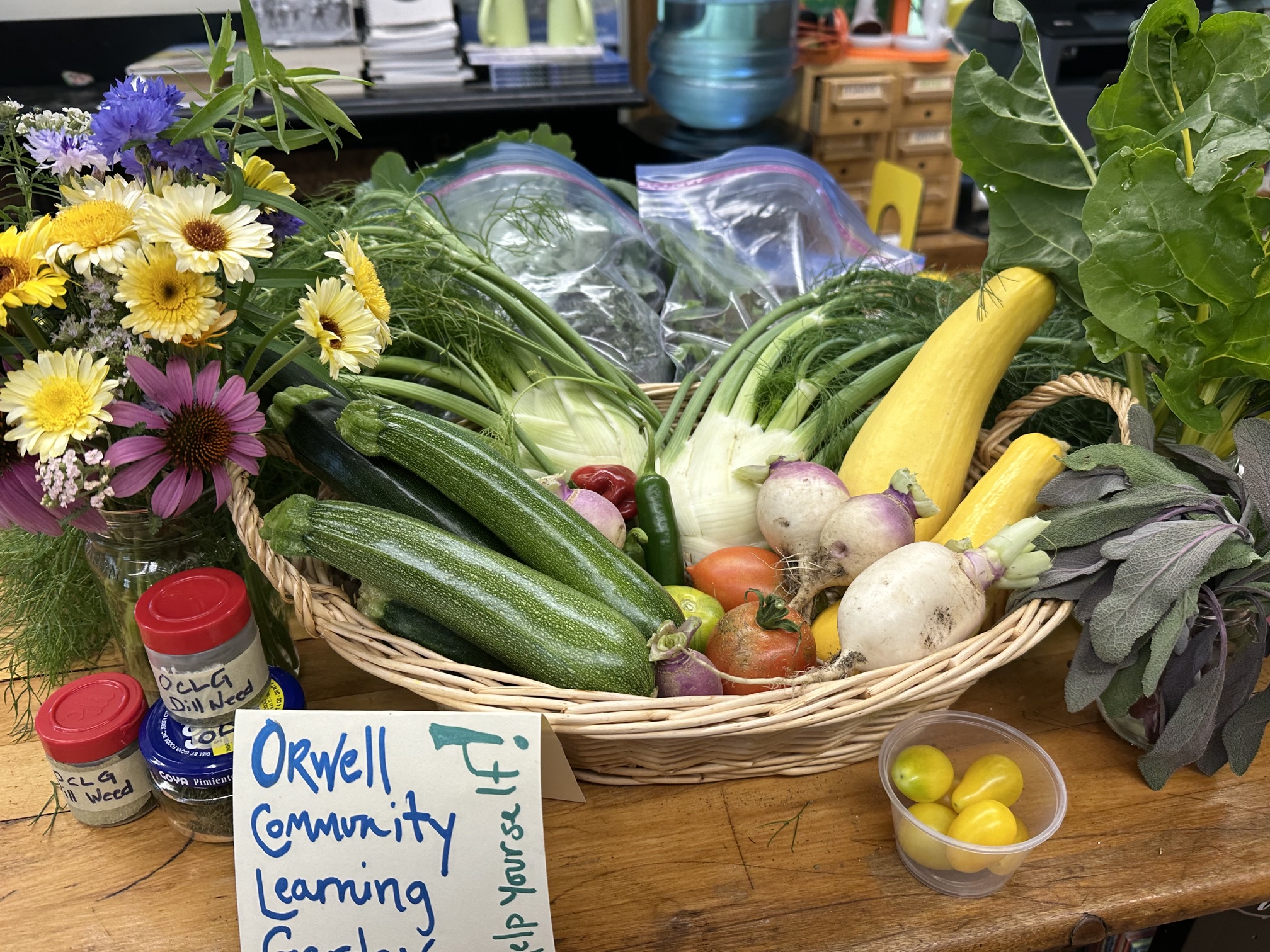
We harvested 8.1 pounds of produce today, including tomatoes (full size and cherry), turnips, celery, sweet and hot peppers, beans, yellow squash, eggplant, fennel, sage, parsley, chamomile, dill, and all our kinds of basil—purple, Genovese, and Tulsi. I was able to make another nice, although small, flower arrangement this week, as well.
We are up to over 34 pounds of produce donated so far, and are really just coming into the weeks where hopefully this will rise quickly with anticipated tomato, cucumber, all the onion varieties, as well as carrots, beets, and other squashes. And, this does not even include what the townspeople are helping us harvest throughout the week when we are not there—keep this up! It is very helpful to us, and we want you all to be able to use it as your own (or supplemental) garden.
Next Thursday, 8/20, will be the last weekday work hours since school at OVS will be starting up the following week. We are going to transition to Sunday mornings at 10 am after that to take us through the fall and end of season. Since the Orwell Free Library will not be open until Tuesdays during the week, look for a picture of the shareable vegetables on the Orwell Community Network on Facebook, or at the Library on Tuesday for anything that can be saved until then.

We’ll leave you with a roasted fennel recipe for the week. This vegetable was not one I thought I would like, since licorice flavor is not my favorite. However, roasting this vegetable mellows the flavor, and it becomes something special. We hope you’ll give it a try!
Until next week, happy gardening!
Karen DeMoy and Christina Shaw, UVM Extension Master Gardeners


The Best Roasted Fennel, courtesy of the Food Network
2 large bulbs of fennel (about 2 lbs, with 2” of tops intact)
4 sprigs of fresh thyme
2 cloves of garlic, thinly sliced or finely minces, about 1 Tbs
¼ cup extra virgin olive oil
¼ tsp crushed red pepper flakes
Salt, to taste
1 lemon, cut into wedges, for serving, optional
Parmesan cheese, grated, for serving, optional
- Preheat ovent o 475 degrees, and make sure one rack is in the middle of the oven.
- Reserve approximately 2 Tbs of the tender, green fronds from the fennel tops, and set aside. Cut the remaining top and bottom from each fennel bulb, then cut the bulb in half lengthwise through the core. Use the tip of the knife to cut an upside down “V” on the bottom of the bulb to remove most of the core, leaving just enough so the bulb stays intact. Cut each half through the core into wedges, about ¼” thick.
- Add the fennel bulb slices, thyme, garlic, olive oil, red pepper flakes, and ¾ tsp salt to a large bowl and toss until even coated. Transfer to rimmed baking sheet.
- Roast in the preheated oven until fennel is very tender and lightly browned in spots, approximately 30-35 minutes. Transfer to serving platter and serve with lemon and/or parmesan cheese, as desired.
August 20, 2026
This Thursday was a really nice day to have our final weekday of the summer—boy that went quickly! We will be pivoting to weekend open hours, to avoid being at the garden during school hours. We discussed trying Sunday hours for something different to open this up to people who may either work during the week, or have busy Saturdays. If this does not seem to work for most of our volunteers, we are open to trying Saturday mornings, or even a weekday in the evening. We’ll see how these next few weeks go, and wait for some feedback.
H joined me this Thursday, and it was perfect for the two of us to do the watering, weeding, and harvesting. There was only 0.3” rain in the gauge, and the beds were dry, so no respite from watering again this week, sadly. Overall, though, this is the part of summer that is a bit less labor intensive in the beds themselves, with less of the work of getting things up and running, and more maintenance. However, it is the time for the hard work of preserving and figuring out all the ways to deal with all the bounty a garden produces. There are countless ways to use your produce, including fresh eating, freezing, canning with boiling or pressure canner, and fermentation, just to name a few. Please be safe with your food handling and preservation, as not all your produce can be handled in the same way for long term storage. Follow this link for more information from UVM on safe preservation tips and techniques: Food Safety for Consumers | University of Vermont…
Today, H and I picked 7.9 pounds of produce that included: eggplant, yellow squash, delicata squash, tomatoes (cherry, paste, full size), green peppers, padron and jalapeño hot peppers, sweet peppers, leeks, shallots, pole beans, kale, and sorrel. I also picked a bouquet of flowers that consisted of: calendula, dill, yarrow, echinacea, baptisia greens, lavender, and bachelor button. It was a beautiful display at the Orwell Free Library this week, and I heard that it was all taken, and people were coming in for more! We love to hear this, and remind anyone that they are welcome to wander up to the gardens anytime to see what is ripe and ready to take home, if there is something they missed at the library. I also heard that some other townspeople are bringing in some of their own garden bounty to share, and this has also been welcome—thank you to all the generous gardeners!


H and I were discussing when to pick some of our allium species—all of the onions and relatives, such as leeks, shallots, and scallions or bunching onions. For the full size onions and shallots, you wait to harvest until the tops of the onions flop over and turn brown, indicating that they have stopped growing. The outside of the bulb will turn papery and brownish. These are then ready to harvest by either pulling them gently out of loose soil, or if you have heavier soil, by using a fork or spade underneath, and gently lifting them out. Shake off the excess dirt, and place them in a dry place out of direct sunlight for a couple of weeks to “cure”, and then they can be stored for at least a few months, maybe longer. If any of them continue to have green shoots, use these right away, as they will not store at all. Some people choose to leave on the brown stems/leaves and braid them for storage. Alternatively, you can cut the leaves, leaving about 1”, prior to storing them in a single layer for good air flow.
Leeks and scallions are harvested differently. Both of these allium species are harvested when the stems are still green and upright. Scallions can actually be harvested at any time, really, as you can use both the small white “bulb”, as well as the green parts. These are harvested by pulling up and then washing right away, leaving the roots intact. These are often used immediately, or stored for 7-10 days in the refrigerator, and there is no need to “cure” them as you would an onion. Leeks are similarly harvested when the shoots are still green and upright, but you will look at the diameter of the white “shank”. A good rule of thumb is to harvest around 1”, although there are some smaller and some giant varieties that reach up to 2” diameter. Once they are ready, you pull them gently, leaving the roots on, and also wash these right away. Both scallions and leeks can be stored in your refrigerator’s crisper drawer—just wrap the bases in a damp paper towel, place them in a bag, but leave it open to prevent excess moisture which can lead to quicker spoilage. Interestingly, some varieties of leeks are suited to overwintering, or at least partial overwintering. If you find you are at the end of the season and you still have a ton of leeks in the ground, try to mound up some dirt and heavy mulch to protect them. They will stay fresh and ready for picking until the temperatures dip below 20 degrees, maybe even colder, if they are mulched heavily. We tried this with our carrots last year, and we harvested them until April, so I am certainly going to try this with our leeks this year! I’ll let you know how it turned out in the spring of 2027.
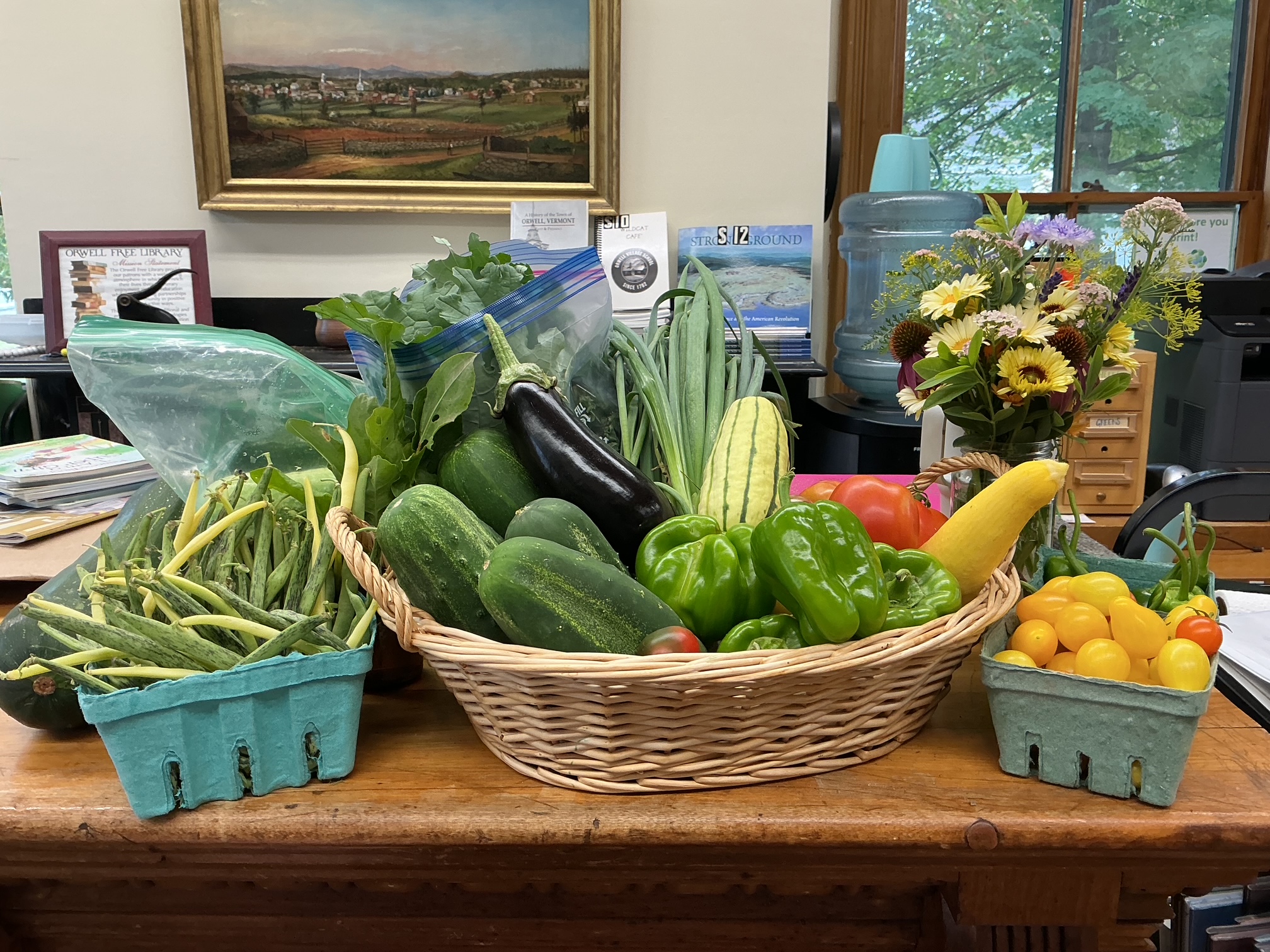
Lastly, I stopped by the garden on Tuesday, 8/25, just to check in and pick a few things, since it was going to be quite a stretch between open sessions. I picked 6.35 pounds of produce, including: sweet peppers, pole beans, tomatoes (full, cherry), zucchini, sage, parsley, rosemary, and purple basil. All of this was brought to the OFL on Tuesday, and soon was off to good homes!
We’ll plan to see everyone on Sunday, Aug 30th at 10 am. Until then, please enjoy one of my family’s favorite pasta recipes to use this time of the year (although we make it all year round, too, but it’s easier now with our own cherry tomatoes and basil available!). I have someone in my book club to thank for this recipe—I’m not sure who brought it first, but we sometimes fight over who gets to bring it, as it is so good, and super easy. Enjoy!
Karen DeMoy and Christina Shaw, UVM Extension Master Gardeners
Roasted Tomato Pasta Salad
1 pound cherry tomatoes, halved (I often use more…)
2 Tbs dried oregano
3 cloves garlic, minced
1 tsp salt
¼ cup extra virgin olive oil
1 pound dried pasta
8-16 oz fresh mozzarella cheese, cubed
½ cup fresh basil, chopped
Dressing:
1/3 cup extra virgin olive oil
2 Tbs balsamic vinegar
½ tsp black pepper
- Preheat oven to 450 degrees.
- Put tomatoes on rimmed cookie sheet, sprinkle with oregano, garlic, and salt. Drizzle with olive oil.
- Roast, uncovered, for 20-25 minutes, until the tomatoes are browned, with some good crispy bits. Set aside.
- Prepare pasta according to directions, drain.
- In a large bowl, whisk together dressing ingredients. Add in warm pasta and toss to coat. Let cool to room temperature.
- Add tomatoes, and scrape all the drippings and good bits from the cookie sheet. Add in mozzarella cheese and basil. Serve at room temperature.
August 30, 2026
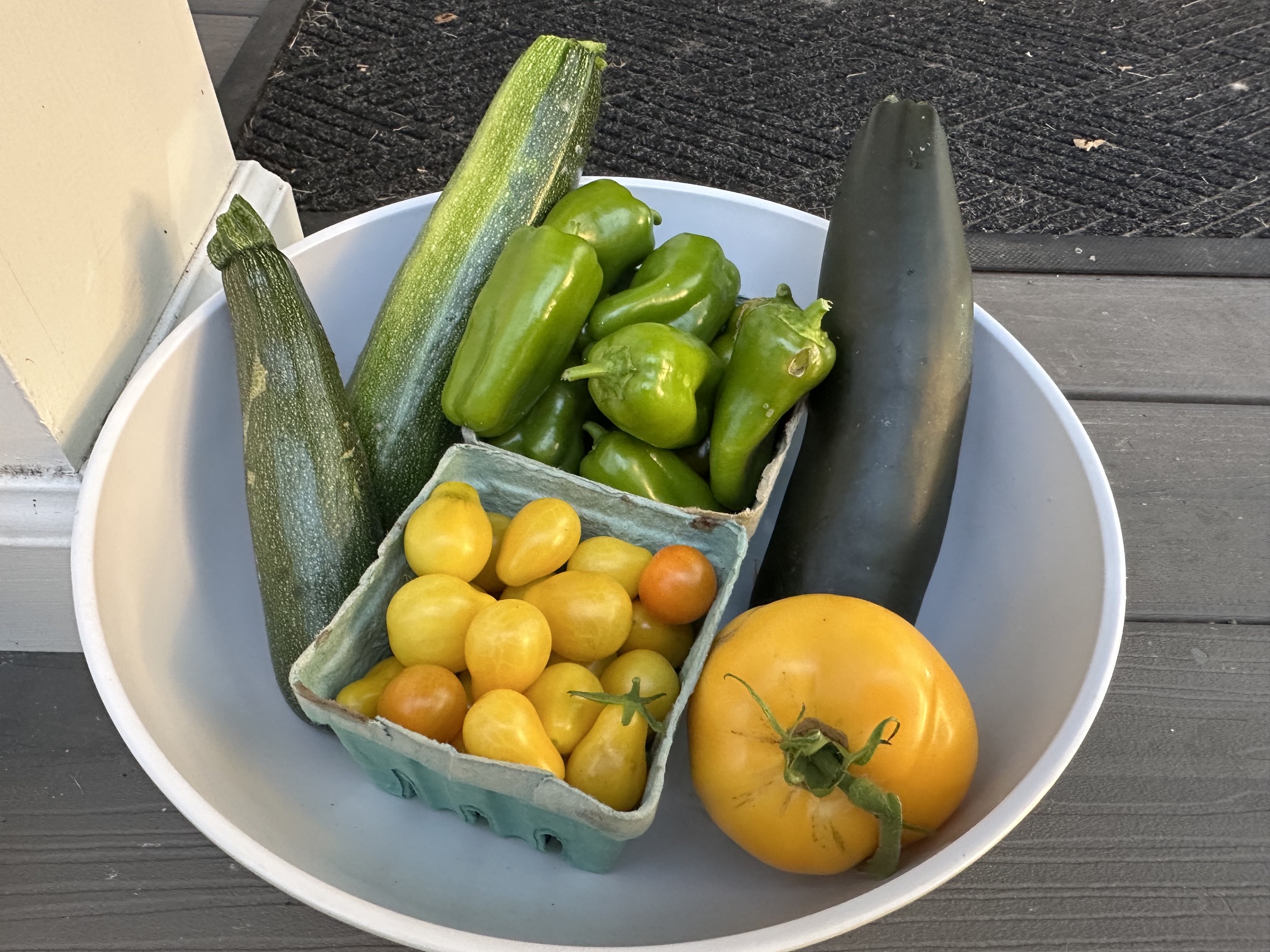
Today we held our first Sunday morning open hours. Christina and H were there for an hour, until it started to rain in earnest. There was 0.3” in the rain gauge, luckily the precipitation began before they drug the hose out to water. We’ll plan to check again during the week and water if necessary. When the plants are as mature as they are currently, and producing so much, their water needs are high. We are hoping to continue to harvest for at least another 6 weeks, until mid October, so we want to keep the plants as healthy as possible.
They harvested some zucchini, lunchbox sweet peppers, and some tomatoes—both yellow pear cherry, and a beautiful full size Goldie tomato. Since the library is not open again until Tuesday morning, for the rest of the season we will be leaving the produce on the front steps of the Orwell Free Library, and we will post a picture on the Orwell Community Network Facebook page, so you can see what is available. We have been so happy to see that people have been harvesting during the week—thank you! This is such a help to us, and is the purpose of this community garden. Also, the school kids are BACK! This is noticeable, in that there were NO beans to harvest on Sunday. This warms our hearts, and even though some of those beans were VERY big (these pole beans can either be harvested while small for fresh eating, or be left on the plant to harvest when they dry, to use the seeds for dried beans).
We had purposely left some of the larger beans in the middle of the tower, to see if we could wait to harvest them and collect the seeds for dried beans, but whether they are eaten now or later, it does not matter, and we are just happy that they are being enjoyed. If anyone wants to weigh any of the produce that they harvest themselves, and let us know, we would appreciate it, but this would just be a bonus for reporting to the UVM Master Gardener Program. You can drop a note or speak with Kate at the OFL, if you have any weigh-ins to share.

You might wonder “why do we keep track of the pounds of food collected/donated?” Each Master Gardener project around the state keeps track of a number of things, including the number of community member interactions, and whether these are with adults or children; what types of questions are asked of us (this is especially relevant for tabling, or “Ask a Master Gardener” events, and may help determine what kinds of workshops or continuing education events are needed); poundage of produce harvested and donated; and, volunteer hours for both certified and intern Master Gardeners. All of this information goes into our year end summaries, and must be submitted to the MG program at UVM. This is the organization that not only educates all of us Master Gardeners, but also helps fund the program, provides materials that we hand out, and supports countless projects all over the state. At its heart, the Master Gardener program promotes not only home gardening, but also educates the public on pollinators, food security and education, and helps us all to foster environmental awareness and sustainable gardening and agricultural practices. We strive to get as many people interested in the land and sustainability, as well as responsible use of chemicals, integrated pest management, composting, and organic gardening practices.
We also learn that there is not just one “right” way to do things, which is why us gardeners love to chat with other gardening fanatics—there is always something to learn! Come find us at our next tabling event—hint, it’s the upcoming Orwell Food and Farm Fest on Sunday, September 13, from 12-4pm. Come pick up a brochure on the MG program, and next year it could be you at the table educating the public, and learning new things.
We have been very fortunate this summer that the weather has been just varied enough that there has not been drought, nor too rainy, conditions. This has resulted in our being able to do some other projects and just “maintain” the beds, i.e., watering, weeding, deadheading. With our good mulching, weeds are mostly suppressed– trying to keep up with them will prevent them from going to seed and causing more weeds in the future. It has been just really nice to harvest vegetables, herbs, and so many flower bouquets this summer. It is a true saying that many hands make light work. Thank you to all of our volunteers this summer so far!
We’ll end this week with another recipe—another tried and true one from our family (and one that has made an appearance at the OFL spring and fall sales when we have soups)—homemade tomato soup with tortellini. Enjoy!
We’re skipping open hours this coming weekend because of the holiday, but we’ll see you back at the garden on September 13, 10 am, and then head over to the Food and Farm Fest at noon.
Karen DeMoy and Christina Shaw, UVM Extension Master Gardeners
Homemade Tomato Soup with Tortellini
1 Tbs extra virgin olive oil
½ cup onion, chopped
3 cloves garlic, minced
2 bay leaves
Dash of crushed red pepper flakes
7 cups crushed or diced tomatoes (skins removed) **can use 2 x 28oz cans of diced/crushed tomatoes if you do not have your own
4 cups chicken or vegetable broth
¼ cup basil, chopped
Salt and pepper, to taste
½ cup sour cream
1 package fresh or dried cheese tortellini
Parmesan cheese, grated, and more fresh basil, for garnish
- Heat the olive oil, onion, and garlic in a soup pot for about 5 minutes, then add red pepper flakes and bay leaves.
- Add the tomatoes, broth, basil, and salt/pepper. Heat to simmer, and cook for approximately 15 minutes.
- Remove the bay leaves and use immersion blender until soup is smooth. Add sour cream.
- Add tortellini and cook 7-8 minutes, or package directions, until tortellini is tender.
- Serve with garnishes.
9/13/26 and 9/19/26
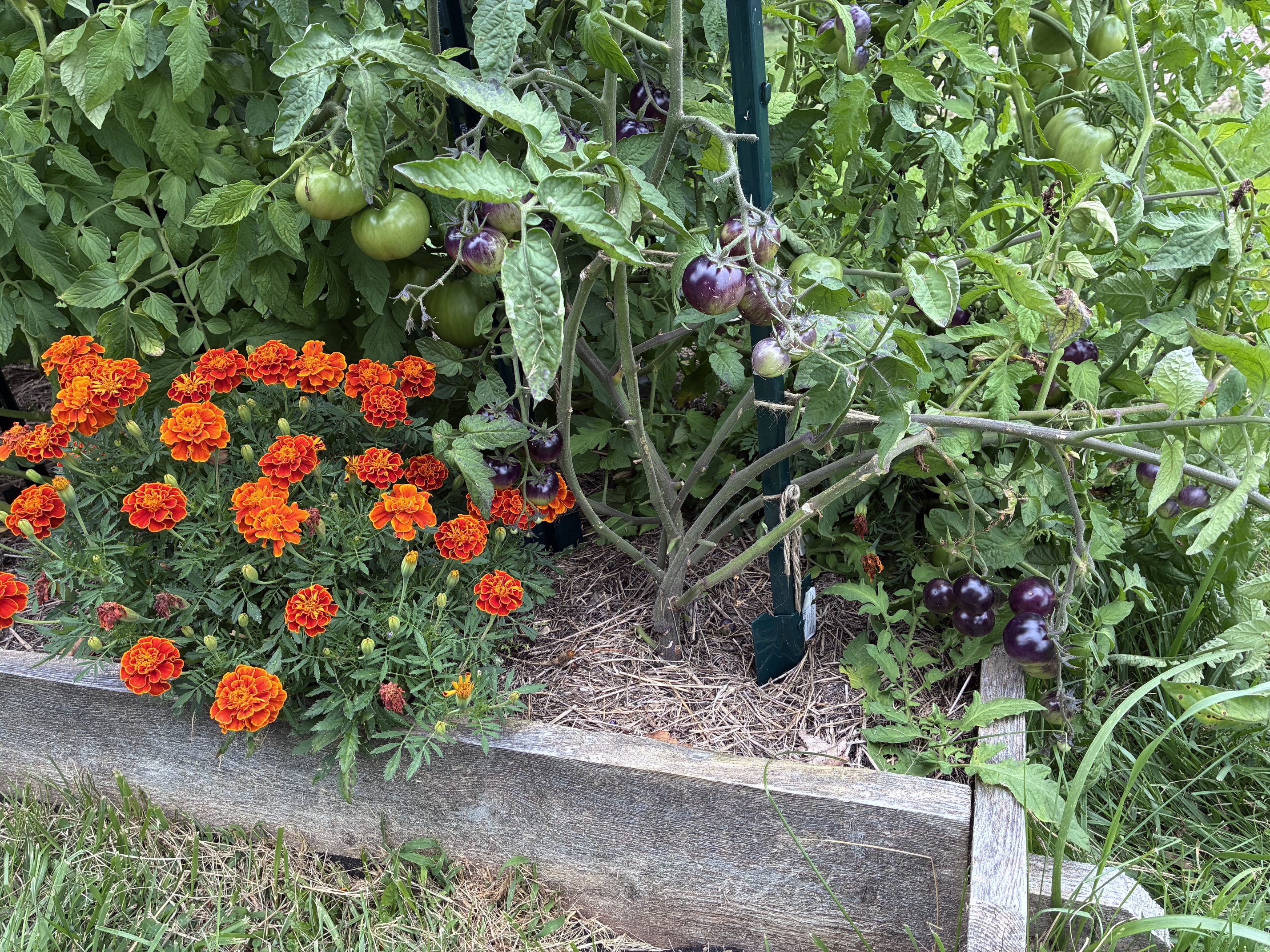
Ok, it has been a little bit since the last post. My last one was in August, then we skipped a week for Labor Day, but were back on Sunday, 9/13, then again Saturday, 9/19. I did stop into the garden multiple times over those weeks, in addition to the open hours, to harvest and make sure there were no disasters. Thankfully, the community continues to harvest, which is wonderful!! The school kids are keeping the pole beans and sungold tomatoes picked clean, which is amazing. Interestingly, they do not seem to enjoy the yellow pear tomatoes as much. The final tomato plant is one I grew from seed from Baker Creek Heirloom Seeds called black strawberry. This is a cocktail sized tomato, which I find to be a very useful size for fresh eating. I purchased 3 different seed types of this size, for their beautiful coloring. Unfortunately, none of them are my favorite tasting tomato. They truly are all beautiful, and make a plate or charcuterie board stunning, but I have used most of them in my sauces, as they are more “meaty” like a paste variety. Oh well, you cannot know unless you try them, and they are certainly not going to waste!

I have some pictures from these past few weeks of some of the plants that are thriving, but also a few with some pests, most notably the squash bug (Anasa tristis). There is one plant in the cucurbit bed that seems to be affected, and we are hoping to prevent it from spreading to the other plants in the bed that still look healthy. You may notice signs of these bugs by their eggs, which are reddish-brown, oval, almost shiny-looking clumps on the underside of the leaves of cucurbit plants (squash, zucchini, cucumber, pumpkins, melons, and relatives).
I did show one picture of the eggs, credit to The Spruce website. (All other pictures on these posts are taken by me, unless otherwise noted.) Then you may notice the wilting of leaves, turning brown, then black, and often huge swarms of the adult grey bugs. While they can fly, they most often move by walking, and so you can prevent them moving to other plants by removing all affected parts of the plants, hand picking the bugs off, and killing any of the egg clumps.

It is important not to compost any of these affected plants or plant parts, because these critters can actually survive the composting process. These bugs also overwinter in the infected plant material and soil, so it is important to remove any debris at the end of the year. You can also encourage beneficial insects that are natural predators of squash bugs, such as parasitic wasps, ground beetles, assassin bugs, and ladybugs. The easiest way to send an invitation to these insects is by planting “companions” that will attract them to your garden. Some of these companion plants include parsley, dill, and cilantro. Also, while you can use organic sprays, be mindful that some of these can kill the beneficial insects, as well. Keeping your garden as free from chemicals as possible will allow these “good” bugs to be able to thrive and help your garden. Squash bug eggs take 10 days to hatch out new nymphs, so checking every few days, picking off any new ones you see, will help keep the population down, as well.

Some of the great produce we have been gathering over the past 3 weeks include many of the above mentioned tomatoes, sweet ball cherry peppers, and green bell peppers, jalapeno and padron hot peppers, scallions, shallots, zucchini, yellow squash, rutabaga, turnips, beets, and kale. There is an abundance of herbs ready, including rosemary, sage (with its companion of verbena—so beautiful!), parsley, dill, basil, thyme, and chives. I have also been busy collecting seeds from the bachelor button, calendula, and Tulsi basil. I have enjoyed gathering flower bouquets this year, as well.
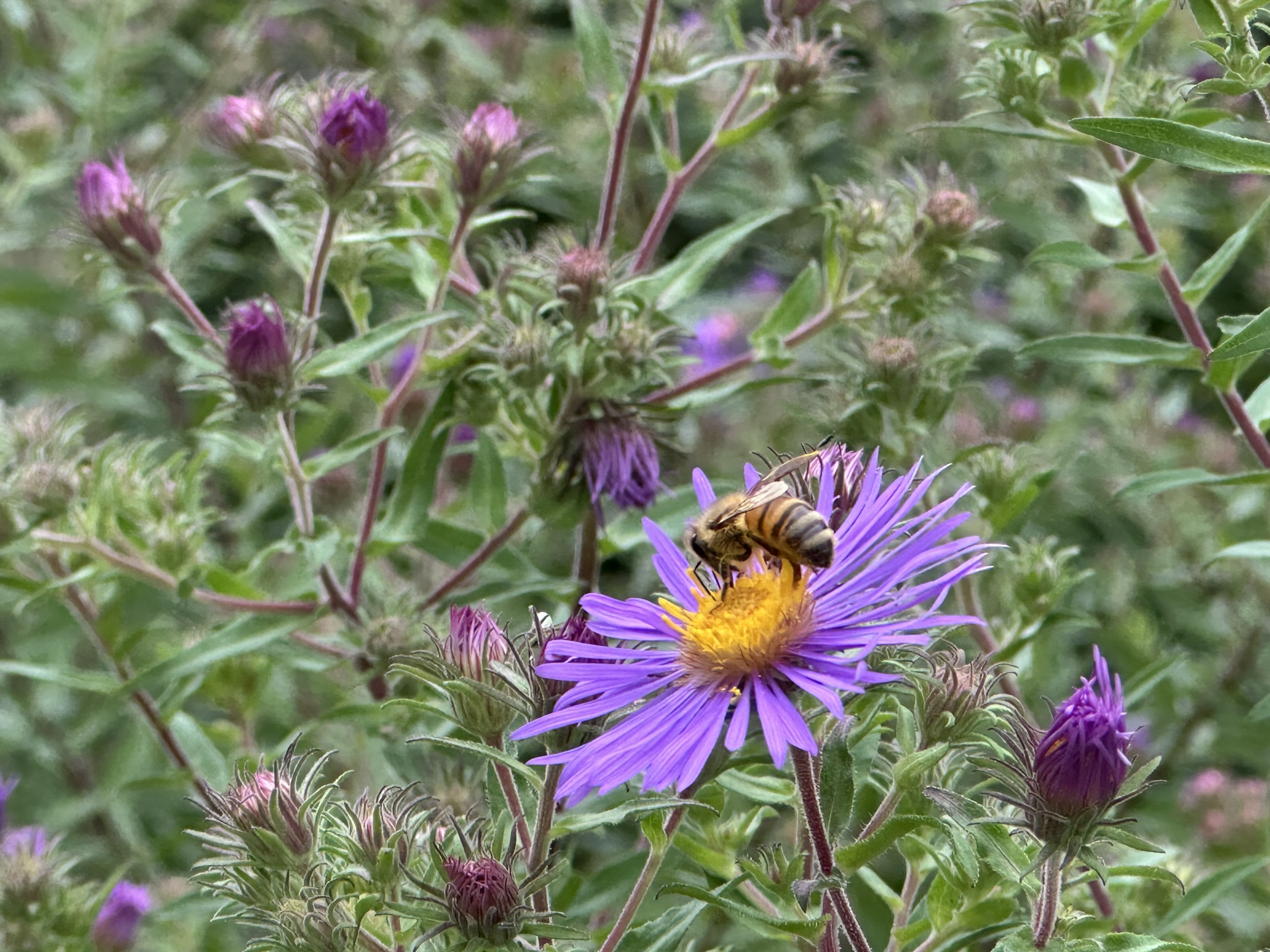
We have gotten creative, using dill, oregano, Tulsi and purple ruffled basil, baptisia, early aster, and mountain mint as greenery in the arrangements. Some of the flowers we have been putting together include echinacea, calendula, yarrow, aster, bachelor button, lavender, marigold, mountain mint, coreopsis, blue vervain, and boneset. We did also add one new perennial this year, from Orwell’s own Green Mountain Natives, a white turtlehead (Chelone glabra). This is a beautiful fall bloomer, and it will be a great addition to the aster that is also flowering right now.

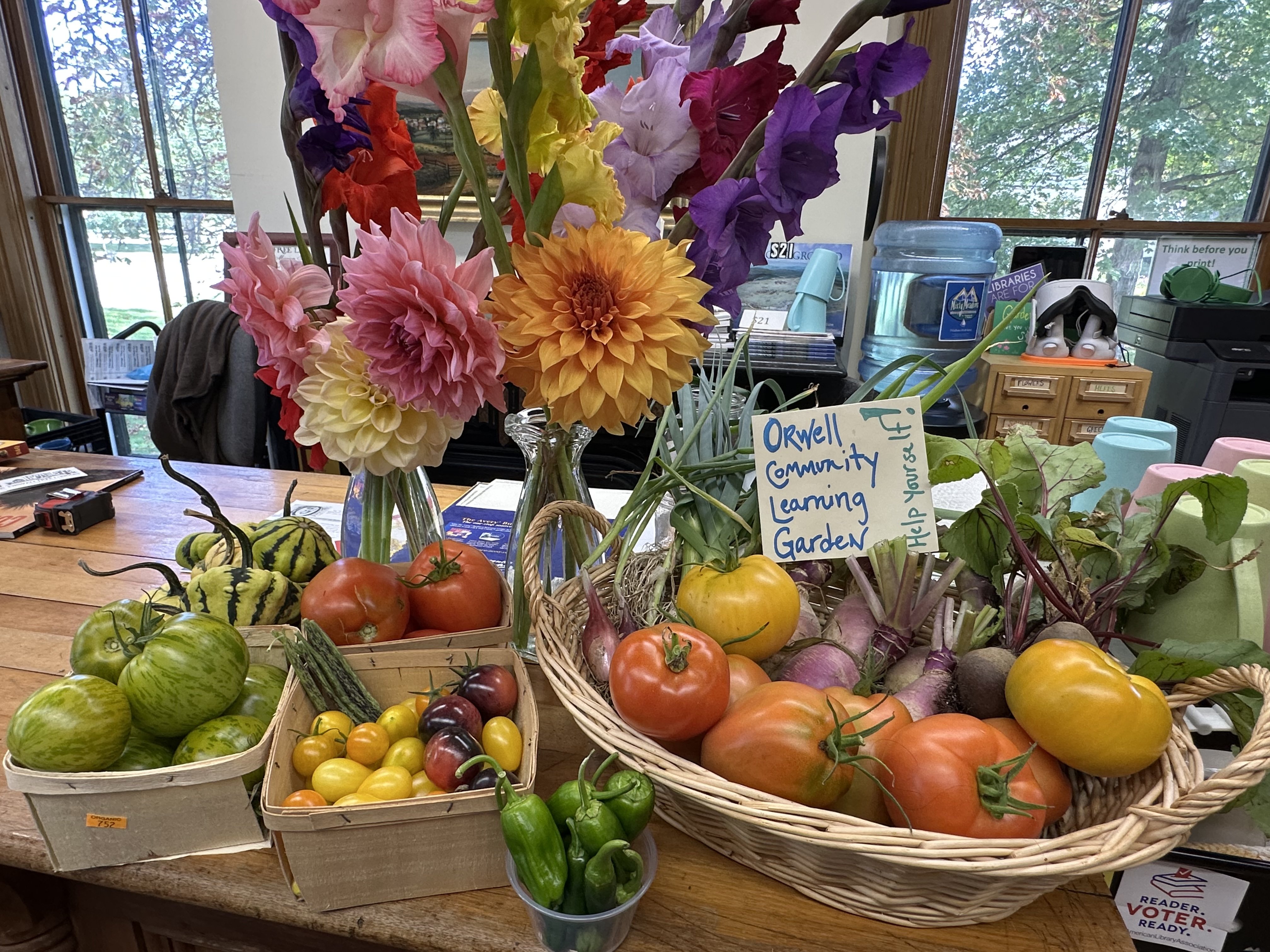
We have been keeping track of our harvests in pounds of vegetables and herbs, and so far we are at over 90 pounds—and this does not include what people have picked on their own. This is wonderful!
We have had a good year so far, with more rain than last year, 0.7” in the past week, and a similar amount in the prior week. With the forecast for rain all day Sunday, we did not water this week. Both Christina and I keep an eye on these amounts, as well as the forecast, and we will either go ourselves to water, or put out a call to the other master gardeners and interns who have been volunteering with us all summer.


On Sunday 9/13, Christina and I were at the gardens, and then Christina moved on to the Orwell Food and Farm Fest at the “Ask a Master Gardener” table with 2 other volunteers for the afternoon. There, they spoke with 43 people about all things gardening. On Saturday, 9/19, we had a family join us at the gardens and we had a good chat about raised beds, blueberries, and what to do with the overabundance of tomatoes.
Carol and Jill, two EMG interns, helped with the beds, and Jill fulfilled her 40 hours of volunteering required to become a certified EMG with us. Congratulations, Jill!
We will be continuing with open hours through mid-October, either on Saturdays or Sundays. If you would like to join us, please call the OFL for the most up-to-date information. This Saturday is the OFL’s Annual Harvest Sale, from 9am-1pm. Come and join us for amazing baked goods, garden produce, pumpkins, and BOOKS! I will also be making flower arrangements for you to take home, as well. See you then!




Karen DeMoy and Christina Shaw, UVM Extension Master Gardeners
Pat’s Zucchini Bread
3 eggs, beaten 1 tsp baking soda|
1 cup oil ¼ tsp baking powder
2 cups sugar ½ tsp salt
2 cups grated zucchini or yellow squash 1 tsp cinnamon
2 tsp vanilla 1 tsp ginger
3 cups AP flour (I substitute 1 cup with whole wheat flour) ½ tsp cloves
1 cup nuts, optional
- Preheat oven to 325 degrees. Grease and flour 2 loaf pans.
- Beat eggs, then add oil, sugar, grated zucchini, and vanilla. Mix well.
- Measure rest of dry ingredients, and add to bowl. Mix well.
- Bake for 1 hour.
- Enjoy!


